
The Theme-Park Wristband Your Nintendo Switch Reads as an amiibo
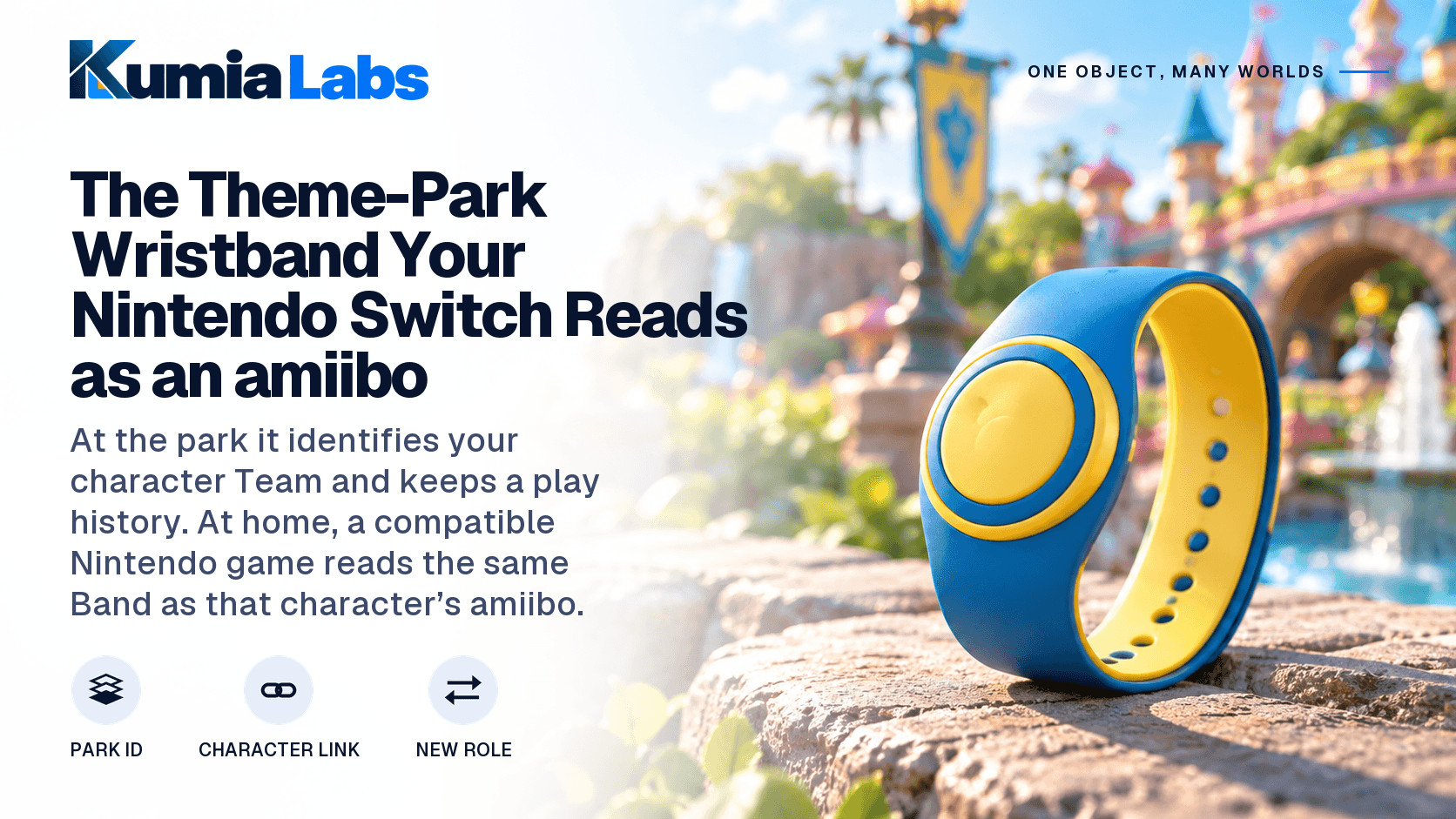

The Band supplies an identity; the place or game decides what that identity means.
A Power-Up Band looks like a souvenir from SUPER NINTENDO WORLD, but it does not keep one job.
SUPER NINTENDO WORLD is a Nintendo-themed area inside three operating Universal destinations: Universal Studios Japan in Osaka, Universal Studios Hollywood in California, and Universal Epic Universe in Florida. The colorful lands turn familiar game ideas—hitting blocks, collecting coins, winning keys—into physical theme-park activities.
The Power-Up Band is the optional character wristband used for that interactive play. It is not a park ticket, not an area-entry reservation, and not a rechargeable smartwatch. It gives the park a way to recognize a player and connect activities to a play history.
amiibo are Nintendo character accessories that compatible games can read at a nearby NFC touchpoint. Most look like figures or cards. The surprising exception is on your wrist: touch a Power-Up Band to a Nintendo Switch or Switch 2, and a compatible game reads it as the amiibo for the character on the Band.
Nintendo Band detail ↗ Nintendo Support ↗ Nintendo park overview ↗
The Band supplies an identity; the place or game decides what that identity means.
Your character choice matters twice
At the park, choosing Mario instead of Yoshi does not buy a stronger Band. Universal's current guide says the standard styles operate identically. One character does not collect better coins or unlock an easier version of a Key Challenge. Universal U.S. guide ↗
The choice still matters. The character places you on that character's Team for park rankings. Take the Band home and the same choice becomes its amiibo identity. A Peach Band means Team Peach in the park and Peach amiibo in a compatible game. A Toad Band means Team Toad in the park and Toad amiibo at home. Nintendo Band detail ↗ USJ Band FAQ ↗
The current standard lineup differs by park. Universal Studios Hollywood documents six: Mario, Luigi, Princess Peach, Princess Daisy, Toad, and Yoshi. Universal Studios Japan documents those six plus Donkey Kong and Diddy Kong. Epic Universe documents the same eight, with the two Kongs available at Universal Orlando Resort in the United States rather than Hollywood. USJ Band FAQ ↗ Universal U.S. guide ↗ Nintendo Hollywood ↗
That gives one design decision two meanings. In the park, the character is your team affiliation. At home, it is the identity a game receives.
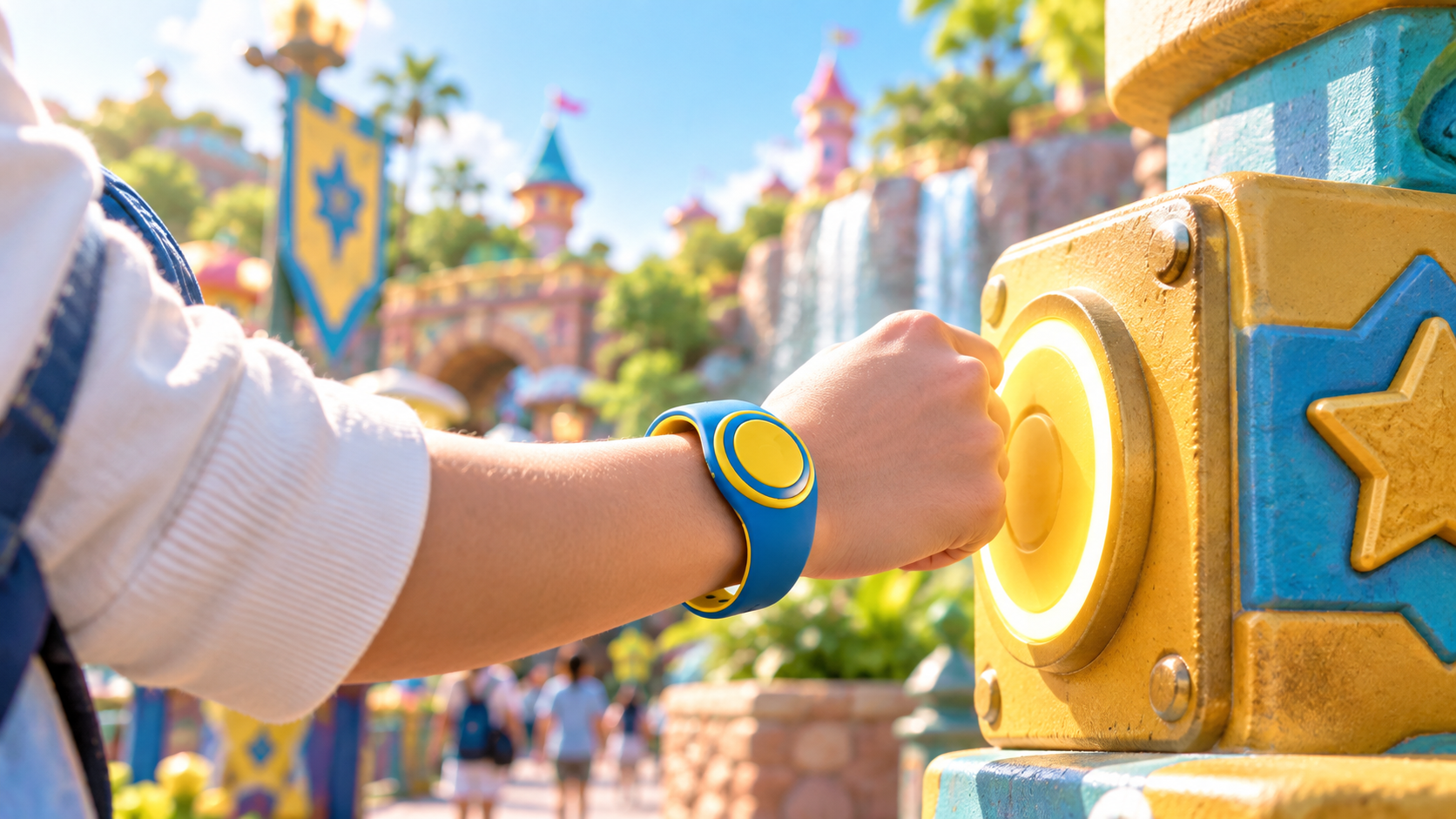
One Band, three readers
It is tempting to explain every role with one magic chip. The official descriptions are more careful—and more interesting.
Inside Universal Studios Japan, the park system uses ambient radio-frequency technology to read an anonymous ID associated with the Band. That is how the physical land recognizes a player and triggers park features. USJ RF terms ↗
The park app approaches the Band through the QR code on its underside. Scan the code to link the Band, see its park-side record, choose a player name, and check rankings. USJ Band FAQ ↗ Universal U.S. guide ↗
Nintendo hardware uses the circular character face on top. Touch that face to the NFC point on a compatible Switch or Switch 2 controller, and the game receives the corresponding amiibo identity. Nintendo Band detail ↗ Nintendo Support ↗
The important point is not what lives in an undocumented memory region. It is that three readers ask three different questions of the same object.
CONCEPTUAL IDENTITY MAP
One Band, three readers
Each context asks a different question of the same object.
- PARK
- Readerambient RF
- Recognizesanonymous Band ID
- Contextual resultplayer / Team / park record
- PARK APP
- Readercamera
- Recognizesunderside QR code
- Contextual resultlink / view / manage that park record
- SWITCH / SWITCH 2
- ReaderNFC touchpoint
- Recognizescircular character face
- Contextual resultcorresponding amiibo in a compatible game
The park remembers the Band
A Power-Up Band is not only a momentary controller. At Universal Studios Japan, its player identity can continue across visits.
USJ says scores and play logs are stored in the cloud. Register the same Band again after reinstalling the app or removing it from the app, and the earlier play log can be viewed again. The USJ app can hold up to ten Bands, allowing a family to switch among several player records on one device. USJ Band FAQ ↗
That persistence also creates a limit. USJ says an existing play log cannot be transferred to a different Power-Up Band. Buying a new Mario or Yoshi design does not turn it into the old player. USJ Band FAQ ↗
The numbers visible in the app do not all run on the same clock. USJ documents an individual history, a daily individual score that resets each day, and a character Team score that resets every hour. Coins, keys, stamps, rankings, and play records are related parts of the park experience, not one universal balance traveling everywhere. USJ Band FAQ ↗
The Band can cross the Pacific; the park records do not merge
Universal Studios Japan explicitly says a Power-Up Band bought at Universal Studios Hollywood can be used in Japan. Universal's Hollywood guide states that a Hollywood Band works in Japan as well. The reuse is real and should be stated plainly. USJ Band FAQ ↗ Hollywood guide ↗
The same sources draw the boundary just as clearly. Japan and Hollywood require their respective park apps. Coins and stamps appear in the app for the park where they were earned. The three keys required for the Bowser Jr. finale must be collected separately in each park. Registering a Band in the other park does not erase the first park's data, but it does not merge the two records either. USJ Band FAQ ↗
Epic Universe creates a third park context through the Universal Orlando app. Current Universal guidance explains how to link a Band there, and an official Universal staff reply says a Japan-purchased Band can work at Epic Universe after being linked to the Orlando app. That is useful evidence for one direction. It is not a complete, durable promise that every Band, app, progress type, and travel direction is interchangeable among all three parks. Universal U.S. guide ↗ Universal Orlando ↗
Japan and Hollywood mutually accept the physical Band, with separate app and progress contexts. For Epic Universe, follow the destination's current official instructions rather than assume a global shared account.
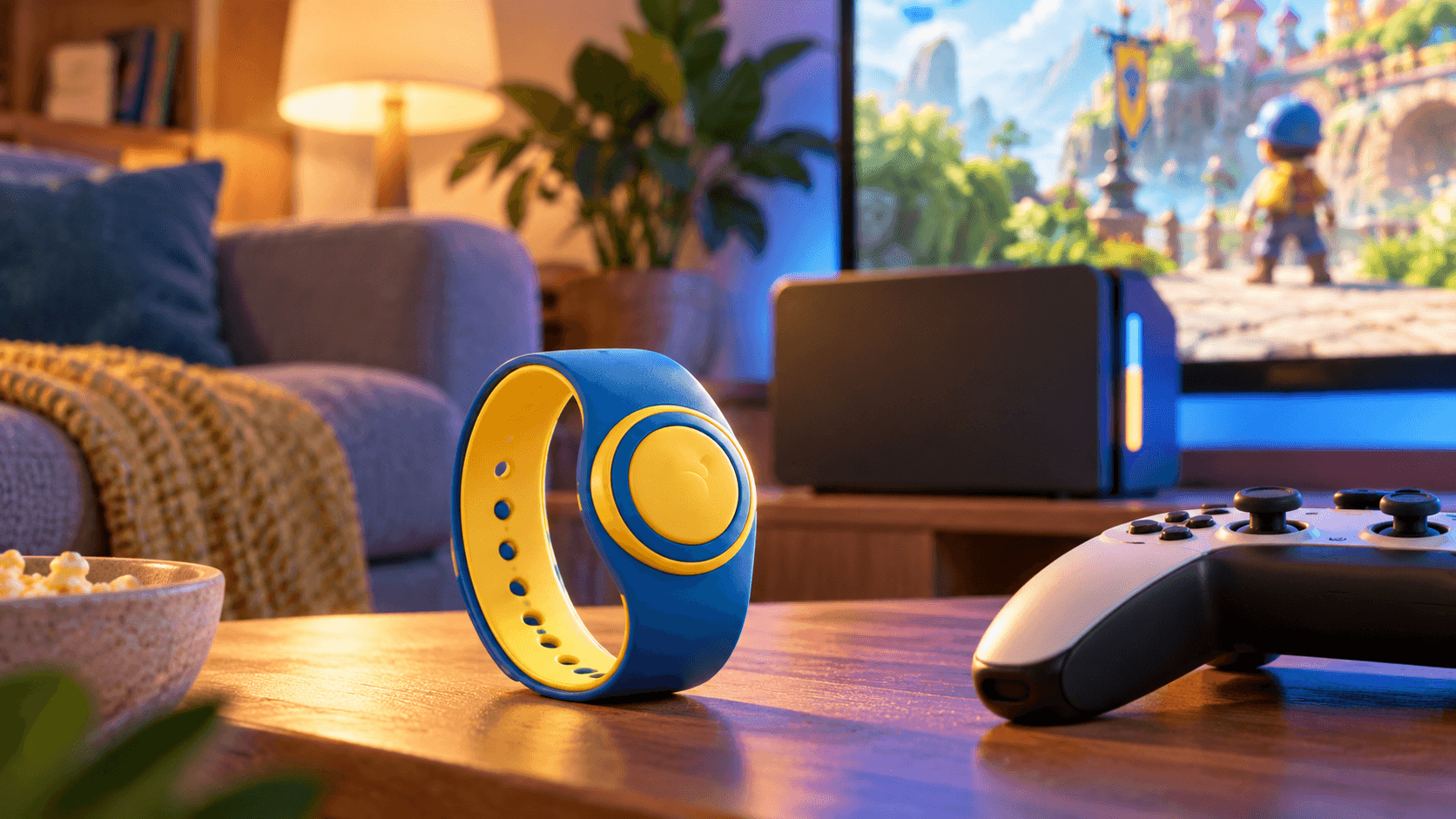
At home, the game writes the verb
“This is a Mario amiibo” tells a game which character identity arrived. It does not tell the game what to do next.
Super Smash Bros. Ultimate provides a clean example. Nintendo says the Mario, Luigi, Peach, Daisy, and Yoshi Power-Up Bands can become Figure Players—fighters that learn and change as they battle. Toad is not a playable Smash fighter, so the Toad Band produces a reward instead. Smash update ↗
The Band did not change characters between those results. The game changed the meaning of the character it received.
Donkey Kong Bananza on Switch 2 offers an even more specific example. Nintendo says the Donkey Kong and Diddy Kong Power-Up Bands produce the same gold KONG panels as the corresponding Donkey Kong and Diddy Kong amiibo figures. The panels can be thrown to explode against enemies or terrain. Bananza support ↗
That is the identity thesis in miniature. In Epic Universe or USJ, a Donkey Kong Band is a park player and Team identity. In Donkey Kong Bananza, the same character identity becomes an explosive in-game object.
Gold can still mean Mario
Limited designs add another role: collectible.
Universal Studios Japan sold a Golden Power-Up Band in 2023. Nintendo says that discontinued Golden Band works as a Mario amiibo. The finish changed; the amiibo character did not. Nintendo Japan Band page ↗
Universal Studios Hollywood later released its own commemorative Golden Power-Up Band, and USJ introduced an “Invincible Mario” anniversary design in 2026. Their existence is official, but the sources used here do not directly state the amiibo identity of those exact editions. They stay out of the Explorer. Appearance is not evidence enough to invent a mapping. Hollywood Golden release ↗ USJ anniversary ↗
“Acts as an amiibo” still has limits
Ordinary amiibo figures can work with older Nintendo hardware, including Wii U and members of the Nintendo 3DS family. Power-Up Bands cannot. Nintendo explicitly limits Power-Up Band amiibo use to compatible software on Nintendo Switch and Switch 2. Nintendo Band detail ↗ Nintendo Support ↗
The same restraint applies to games. A game can support some character amiibo but not others. It can turn one Band into a trainable fighter and another into a reward. It can give Donkey Kong a special response and treat unrelated amiibo generically.
Do not read “Power-Up Band = amiibo” as “every game does something special.” The Band supplies a character identity; compatibility and function still belong to the game.
POWER-UP BAND IDENTITY EXPLORER
Which identity does your Power-Up Band carry?
Select one of the eight standard characters. The result shows the Band's park Team, documented standard park availability, corresponding amiibo identity, console support, one verified game example, and the travel boundary that applies.
Eight standard characters only. Limited editions are intentionally excluded.
Selected identity
Mario
- Park identity
- Team Mario
- Current documented standard locations
- Universal Studios Japan, Universal Studios Hollywood, and Universal Epic Universe
- Home identity
- Mario amiibo
- Console support
- Nintendo Switch and Nintendo Switch 2
- Not supported
- Nintendo 3DS family and Wii U
- Verified game example
- Super Smash Bros. Ultimate: can become a Figure Player.
- Travel / park-specific note
- Japan and Hollywood mutually accept the physical Band, but each park keeps a separate app and progress record. Epic Universe uses a separate Orlando setup; complete three-park interoperability is not verified.
Boundary: Game effects vary by title. This does not transfer park progress to a console or merge progress between parks.
Sources checked 2026-09-21: Nintendo Band detail ↗USJ Band FAQ ↗Universal U.S. guide ↗Smash update ↗
Two games that make the second life visible
If you already own a Donkey Kong or Diddy Kong Band and a Switch 2, Donkey Kong Bananza is the most direct modern demonstration in this article: Nintendo explicitly documents the Power-Up Band reaction.
Super Smash Bros. Ultimate is the secondary example because it reveals a different kind of identity: five Bands become Figure Players, while Toad becomes a reward.
Amazon links below are paid links. Kumia Labs may earn from qualifying purchases at no extra cost to you.
RECOMMENDED
Donkey Kong Bananza
Nintendo documents Donkey Kong and Diddy Kong Power-Up Bands producing gold KONG panels. This does not imply that the game requires a Band, and it does not promise the Pauline amiibo's Diva Dress.
View Donkey Kong Bananza on Amazon.com →(paid link)ALSO WORTH A LOOK
Super Smash Bros. Ultimate
Mario, Luigi, Peach, Daisy, and Yoshi Bands can become Figure Players. Nintendo says the Toad Band gives a reward instead.
View Super Smash Bros. Ultimate on Amazon.com →(paid link)Donkey Kong Bananza requires a Nintendo Switch 2. If you don't already own one, that's a separate purchase from the game or the Band.
As an Amazon Associate, Kumia Labs earns from qualifying purchases. See the Affiliate Disclosure for details.
OFFICIAL · NON-AFFILIATE
Looking for a Power-Up Band in the United States?
Universal's current guide lists purchase locations in and around its U.S. parks. Kumia does not substitute a resale listing or invent an online Universal checkout page.
Check Universal's current U.S. purchase locations and app setup →One object, many worlds
A Power-Up Band can begin as a souvenir you wear. At a park interaction, it becomes a player identity, a character Team, and the thread connecting today's play to a later visit. In another documented park, the same physical object can enter a separate local record. At home, a Switch reads its character face as an amiibo.
None of those roles is the single “real” one. They gather around the same object, waiting for a park system, phone camera, or Nintendo game to ask a different question.
The clever part is not only that a wristband works with a console. It is that the Band keeps supplying the same character identity while each world decides what that identity can do.
Sources and methodology
This article uses Nintendo and Universal first-party pages reviewed for the final Kumia research package and checked September 21, 2026. Kumia did not reverse-engineer or physically test a Power-Up Band. Japan/Hollywood mutual reuse is stated only with separate app and progress contexts; the article does not claim complete three-park interoperability. Limited-edition mappings are omitted unless a first-party source states them. Amazon links use verified ASINs for the two named products above; Kumia Labs earns from qualifying purchases through those links. Prices, sellers, stock, resale Bands, and unofficial NFC products are outside this article.
- Nintendo U.S.: Power-Up Band amiibo detailCorresponding-character amiibo identity, Switch and Switch 2 support, NFC touch location, legacy-hardware exclusion, and U.S. DK/Diddy availability.
- Nintendo Japan: Power-Up BandCorresponding-character rule and the discontinued USJ Golden Band acting as Mario amiibo.
- Nintendo Support: Power-Up Band overviewPark functions, amiibo role, touch instructions, and Wii U / Nintendo 3DS-family exclusion.
- Universal Studios Japan: Power-Up Band app and FAQEight standard types, equal benefits, Teams, cloud play log, ten-Band app limit, no log transfer, and Japan/Hollywood reuse with separate data.
- Universal Studios Japan: Power-Up Band Key ChallengesCoins, stamps, keys, amiibo use, and the distinction between the Band and park admission.
- Universal Studios Japan: Power-Up Features termsThe park system reads an anonymous Band ID using ambient radio-frequency technology.
- Discover Universal: Complete Guide to Power-Up BandsCurrent Hollywood/Epic lineups, equal standard operation, Teams, QR setup, amiibo role, and official U.S. purchase locations.
- Discover Universal: SUPER NINTENDO WORLD Hollywood guideHollywood features, persistent play history, Team framing, and explicit Japan portability.
- Nintendo: SUPER NINTENDO WORLD overviewThe three operating destinations and the Band's park and amiibo roles.
- Universal Orlando: SUPER NINTENDO WORLD detailsEpic Universe activities and its Super Mario Land and Donkey Kong Country areas.
- Nintendo: Donkey Kong Bananza amiibo supportDonkey Kong and Diddy Kong Power-Up Bands produce the verified gold KONG-panel reaction.
- Nintendo Support: Super Smash Bros. Ultimate update historyMario, Luigi, Peach, Daisy, and Yoshi Bands work as Figure Players; Toad gives a reward.
- Universal Studios Hollywood: 2024 Golden Band releaseThe commemorative Hollywood Golden Power-Up Band existed; the source does not establish its amiibo identity.
- Nintendo: Universal Studios Japan fifth anniversaryThe Invincible Mario anniversary design exists; the source does not establish its amiibo identity.
- Nintendo: SUPER NINTENDO WORLD Hollywood openingHollywood's six standard designs, individual and Team scores, coins, keys, and ride integration.