
The KitchenAid Connection That Reaches Back to 1919


One hidden connection outlasted a century of kitchen design. The bowl right beneath it did not.
KitchenAid currently says that all of its power-hub attachments fit every KitchenAid stand mixer model made since 1919.KitchenAid UK ↗
Read that once more. A tool sold for a modern kitchen—something like a pasta roller, food grinder, or slicer—belongs to an attachment ecosystem that KitchenAid says reaches back to stand mixers made more than a century ago.
How did a kitchen appliance preserve that kind of cross-generation compatibility?
The answer is not that the entire mixer stayed the same. It did not. KitchenAid changed the body, bowl mounting system, capacity, controls, materials, and specialized tools over generations. What endured was one particular kind of connection: the covered power hub at the front of the machine.
Then comes the twist. The bowl directly beneath that hub does not inherit the same sweeping rule. KitchenAid divides current bowls into Mini tilt-head, full-size tilt-head, and bowl-lift families, and it warns that bowls are not interchangeable across those types.Bowl guide ↗
One machine therefore contains two different compatibility stories. The front hub is about transferring power. The bowl is about physically supporting the work in precisely the right place.
1919: the mixer was already more than a mixer
KitchenAid dates its household stand-mixer story to the H-5 of 1919. The remarkable detail is not merely that the machine existed. KitchenAid’s official history says the H-5 offered attachments for slicing and straining and was conceived as a food-preparation tool.KitchenAid history ↗
From the beginning, the motor could be shared with another job. Instead of buying a separate powered machine for every task, the owner could connect a different mechanism to the mixer.
That platform-like idea remains visible in today’s catalog. Current KitchenAid power-hub attachments roll pasta, grind meat, slice and shred vegetables, spiralize produce, mill grain, dice ingredients, sift flour, and make shave ice.Attachment guide ↗
1919 · H-5
Slicing and straining
KitchenAid’s official history says the H-5 offered attachments for slicing and straining and was conceived as a food-preparation tool.
Today
The same motor, many more jobs
- Rolling pasta
- Grinding meat
- Slicing and shredding
- Spiralizing produce
- Milling grain
- Dicing and sifting
- Making shave ice
The oldest story and the newest catalog even rhyme. Slicing and straining appeared in KitchenAid’s 1919 history; slicer/shredder and fruit-and-vegetable-strainer systems remain modern options. This is a continuity of purpose, not proof that the 1919 and current hardware are identical.
1937: the famous shape and a new bowl relationship
The attachment idea came before the KitchenAid silhouette most people now recognize.
KitchenAid credits industrial designer Egmont Arens with work on the Model K family. Its timeline places the Model K launch in 1937 and says that model introduced a bowl secured to the base with an interlocking motion, along with the form that became KitchenAid’s visual signature.KitchenAid history ↗Brand history ↗
A Museum of Modern Art exhibition checklist independently identifies a KitchenAid electric mixer designed by Arens and manufactured by Hobart. The mixer had become not only a kitchen tool but an industrial-design object.MoMA checklist ↗
That 1937 milestone matters to this story because it makes the two paths visible. The mixer’s front connection continued to turn external tools. Underneath, the bowl was becoming part of a specific physical architecture: it had to lock to the machine and align with the moving beater.
1969: the K-45 milestone
KitchenAid describes the K-45, introduced in 1969, as its most popular mixer to that point. It sits in the historical line between the early household machines and the familiar tilt-head family that many owners recognize today.KitchenAid history ↗
The mixer continued evolving around a recognizable design language. KitchenAid had introduced color in 1955; later generations expanded capacities, materials, controls, and specialized tools. The object remained familiar without remaining physically identical.Old vs. New guide ↗
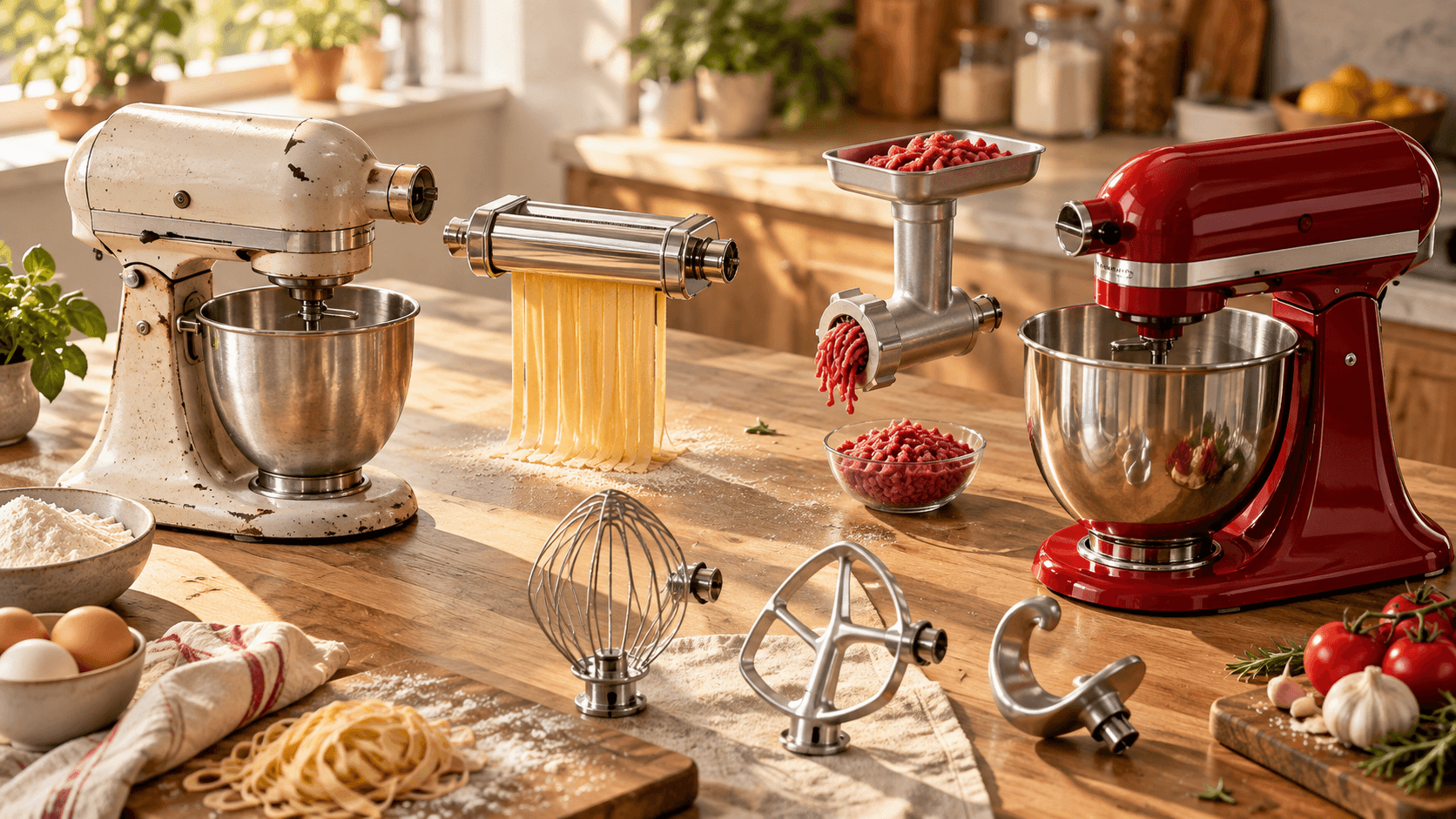
Present: an attachment claim that reaches back to 1919
KitchenAid’s current wording is unusually broad. Its UK product page says all power-hub attachments fit every KitchenAid stand mixer model made since 1919. Its US support material says attachments that enter the universal power hub fit all stand mixers regardless of age.KitchenAid UK ↗KitchenAid support ↗
That evidence supports a strong, carefully attributed statement:
KitchenAid says today’s power-hub attachments fit stand mixer models made since 1919.
It does not support several more dramatic claims. It does not prove that every internal dimension, material, or manufacturing detail stayed literally unchanged. It does not mean every object marketed as a KitchenAid “attachment” uses the front hub. It does not certify the condition or safety of an antique mixer or incomplete used accessory. And it does not mean we tested a current attachment on a 1919 H-5.
The documented achievement is cross-generation fit, not a machine frozen in time.
Why the small front hub could carry the long story
Remove the cap at the front of a KitchenAid stand mixer and a power connection appears. KitchenAid’s installation guidance describes an attachment shaft entering a square socket and being secured with the attachment knob. The mixer motor then turns the mechanism inside the connected tool.How to use ↗
In plain language, the hub lends the mixer’s motor to another small machine. The pasta roller, grinder, slicer, or mill does its work in front of the mixer.
- Mixer motorTurns the drive.
- Front power hubA covered square socket.
- Attachment shaftEnters the socket and is secured with the attachment knob.
- Independent toolThe mechanism inside the pasta roller, grinder, slicer, or mill.
Meanwhile, underneath: the bowl sits on a different path. It has to be supported, aligned, and matched to the beater, not turned by the hub.
That physical separation helps explain the compatibility story. A front-mounted pasta roller does not need to know whether the mixing bowl below twists into the base or hangs from lift arms. It does not need the bowl to be stainless steel, glass, or ceramic.
This is an interpretation of documented product architecture, not KitchenAid’s stated century-long strategy. No reviewed primary source says that the company deliberately froze an identical standard in 1919 with a hundred-year plan. What KitchenAid documents is the present result: broad hub-attachment fit across age and model.
The front hub is a POWER INTERFACE. It primarily has to transmit rotation securely to a separate mechanism.
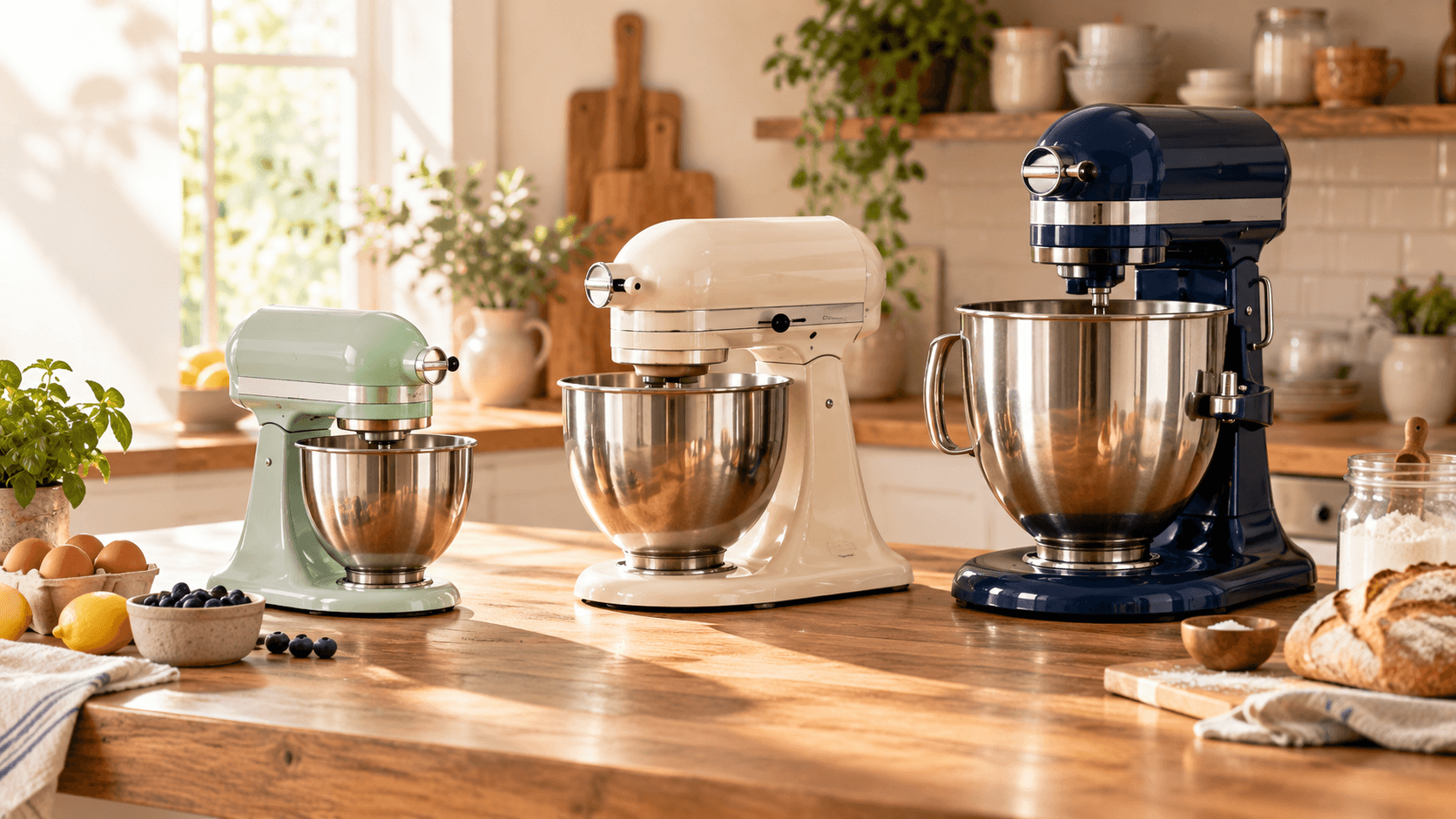
The twist: bowls obey physical support and geometry
A mixing bowl solves a different problem. It is not simply a container sitting near the machine. It must mount securely, remain stable under load, sit at the correct height, clear the mixer body, and match the path of the beater, whip, or dough hook.
- Mini tilt-head
- Full-size tilt-head
- Bowl-lift
Mini tilt-head
A separate, compact bowl family.
Full-size tilt-head
The bowl twists into a clamping plate on the base.
Bowl-lift
The bowl locks on support arms and rises toward a fixed head.
KitchenAid currently organizes bowls into three broad families: Mini tilt-head, full-size tilt-head, and bowl-lift. KitchenAid says bowls are not interchangeable across these mixer types.Bowl guide ↗Mixer buying guide ↗
The Mini and full-size models both tilt, but the Mini is a smaller system with its own bowl geometry. A full-size tilt-head bowl twists into a clamping plate on the base. A bowl-lift bowl attaches to support arms, locks at the rear, and rises toward a fixed head.
These are PHYSICAL SUPPORT / BOWL GEOMETRY systems. Changing the mixer architecture changes where the bowl sits and how the tool moves inside it.
KitchenAid does not provide one historical statement declaring why all bowl families diverged. The factual part is the documented separation of bowl types and model lists. The conceptual explanation, that bowl compatibility is constrained by mount, position, depth, height, and tool path, is an interpretation grounded in that documented architecture.
“Six quart” is not an interface
Capacity is a useful measurement, but it is not a compatibility standard.
KitchenAid lists the KSMB60 six-quart stainless bowl for current residential bowl-lift models beginning with KSM55, KSM60, KSM70, and KSM75. A different six-quart bowl, KN2B6PEH, lists older KD2661, KL26M, KP26, and KV25 families.KSMB60 ↗KN2B6PEH ↗
Both are KitchenAid bowls. Both are bowl-lift products. Both are described as six quart. Their official model lists differ.
The number tells you how much a bowl holds. It does not tell you where support pins sit, how the bowl latches, or which tool sweeps it correctly.
A second bowl for a bowl-lift mixer
KSMB60 six-quart stainless bowl
Listed for current residential bowl-lift models beginning with KSM55, KSM60, KSM70, and KSM75.
Watch for: match your exact model to the list on KitchenAid’s page. Don’t choose by capacity.
A second bowl for an older bowl-lift mixer
KN2B6PEH six-quart bowl
Lists older KD2661, KL26M, KP26, and KV25 families.
Watch for: its model list differs from the KSMB60’s, so confirm your exact model.
The Ice Cream Maker exposes the boundary
Tilt-head path
KitchenAid says it fits all tilt-head stand mixers except the Artisan Mini KSM3316 and KSM3317.
Bowl-lift path
KitchenAid says it fits all bowl-lift stand mixers except the K5SS, KSM50, KSM500, and KSM450.
Still not universal
- Excluded, tilt-head: Artisan Mini KSM3316 and KSM3317.
- Excluded, bowl-lift: K5SS, KSM50, KSM500, and KSM450.
- Verify model: vintage or unidentified mixers, including KPM5 and KSM5, where KitchenAid’s own lists don’t agree.
The Ice Cream Maker is the most useful weird exception because it looks like a bowl but behaves like a small system.
The KSMICM replaces the ordinary mixing bowl with a freeze bowl. A dasher churns inside it, and a drive assembly transfers motion from the mixer. KitchenAid documents different positioning for tilt-head and bowl-lift machines.KSMICM ↗Ice cream how-to ↗
That extra hardware lets one product bridge two mixer architectures, but not universally. KitchenAid’s current product page says the KSMICM fits all tilt-head stand mixers except the Artisan Mini KSM3316 and KSM3317, and all bowl-lift stand mixers except the K5SS, KSM50, KSM500, and KSM450. Older models are murkier: its how-to material, manual, and printable guide do not present identical lists for every older model.KSMICM ↗Printable guide ↗
The correct lesson is narrow and useful: when an accessory depends on bowl/base geometry rather than only the universal front hub, model-specific exceptions return. Do not generalize beyond the officially documented models. For legacy models appearing inconsistently across KitchenAid sources, the result remains VERIFY MODEL.
Other exceptions that reveal the system
The attachment fits; the supplied carafe does not
KitchenAid says the Juice and Sauce attachment fits the Artisan Mini’s power hub, but the supplied carafe is too tall. The company recommends using a suitable shorter vessel.KitchenAid support ↗
The power connection works. The full kitchen arrangement does not, until a third object changes.
A visible gap can still be correct
KitchenAid says a gap of up to 1/8 inch between an attachment housing and the mixer can be acceptable when the attachment is correctly inserted, secured, and unable to move.KitchenAid support ↗
The visually seamless fit is not the only test of mechanical fit.
The mixer matches; the bowl material does not
The KSMPB7 bowl-lift pastry beater supports a list of mixers, yet KitchenAid approves it only with stainless-steel bowl-lift bowls. A listed mixer using a glass bowl is not the approved combination.KSMPB7W ↗Accessory guide ↗
The sifter accepts common bowls, then rejects special systems
KitchenAid says the Sifter + Scale can work with accessory stainless-steel, glass, and ceramic bowls. It separately excludes use with the Ice Cream Maker, Precise Heat Mixing Bowl, and Pouring Shield configuration.Sifter + Scale ↗
A small-batch bowl can bring its own whip
The KN3CW three-quart bowl for selected bowl-lift mixers is supplied with a Combi-Whip. It is a paired small-batch system, not evidence that every ordinary bowl-lift tool belongs in the shallower bowl.KN3CW ↗
Old and new combinations worth trying
Your existing mixer may already support the modern power-hub attachment. A new mixer may not be necessary.
A modern pasta roller on an inherited mixer
This is the cleanest expression of KitchenAid’s current hub claim. Confirm that the product is a genuine power-hub attachment and that both the mixer and accessory are complete, maintained, and safe to use.
Add a modern function to an inherited mixer
Genuine KitchenAid power-hub attachments
Pasta rollers, grinders, slicers, spiralizers, grain mills, and other attachments that use the front power hub.
Watch for: check that the piece is genuine and that a used accessory is complete and safe. Your existing mixer may already be enough.
A 1919 job with a modern tool
Use a current slicer/shredder or fruit-and-vegetable-strainer path to revisit jobs KitchenAid associated with the H-5. Describe this as continuity of function, never identical hardware lineage.
Revisit an early slicing or straining job
Current slicer/shredder or fruit-and-vegetable-strainer path
Modern versions of the jobs KitchenAid’s 1919 history associates with the H-5.
Watch for: the strainer needs the companion hardware KitchenAid specifies. This is continuity of function, not the same hardware.
Grain to loaf on a full-size tilt-head
A Grain Mill or Sifter + Scale uses the front hub; the Bread Bowl uses the tilt-head bowl mount. The workflow deliberately combines the broadly compatible power interface with a model-specific support interface.
Bake in one vessel
KSM2CB5BGS Bread Bowl
Documented for supported 4.5/5-quart full-size tilt-head mixers. The product page states a 500°F limit.
Watch for: the KN15E1X is excluded, and the beater clearance may need adjusting. Not for the Mini or bowl-lift models.
Ice cream on a supported tilt-head or bowl-lift mixer
KSMICM demonstrates how a drive assembly can bridge two architectures while retaining named exclusions. Exact model verification is part of the combination.
Make frozen desserts
KSMICM Ice Cream Maker
Freeze bowl, dasher, and drive assembly, with different positioning for tilt-head and bowl-lift machines.
Watch for: it excludes the Artisan Mini KSM3316 and KSM3317 and the K5SS, KSM50, KSM500, and KSM450. KitchenAid’s lists for some older models differ, so verify your exact model.
Small batches through two different systems
A listed full-size tilt-head model can use the KB3SS three-quart bowl. A listed bowl-lift model can use the KN3CW bowl with its supplied Combi-Whip. The goal is the same; the mount and tool assumptions are not.
Make small batches on a tilt-head mixer
KB3SS three-quart stainless bowl
Documented for full-size tilt-head models.
Watch for: KitchenAid’s page lists supported models, and its lists differ between sections. Check every list for your exact model.
Make small batches on a bowl-lift mixer
KN3CW three-quart bowl with Combi-Whip
A paired small-batch set for bowl-lift models.
Watch for: the bowl and Combi-Whip are one system, and KitchenAid’s model lists differ between sections of the page. Check every list for your exact model.
Pastry through two architectures
Full-size tilt-head and bowl-lift mixers use different pastry-beater families. The bowl-lift version can add a material condition: stainless steel only for the documented product.
Cut cold butter in a bowl-lift mixer
KSMPB7W pastry beater
Documented for listed bowl-lift models.
Watch for: KitchenAid approves it only with stainless-steel bowl-lift bowls, not glass.
ONLY NOW: THE PRACTICAL PART
What Survived? KitchenAid Combination Explorer
Answer up to three questions. The explorer only knows the combinations in Kumia’s verified dataset, and it says VERIFY MODEL whenever KitchenAid’s sources don’t settle it.
Start with your mixer to see a result.
What to verify before buying
Find the exact mixer model
KitchenAid advises checking the identification label on the bottom of the base. Model number is more reliable than color, apparent age, or estimated capacity.
Identify the interface
Does the item enter the front power hub, attach to the beater shaft, or replace/support the bowl? The word “attachment” is too broad to answer compatibility by itself.
Check the hidden condition
Look for bowl material, exact exclusions, required companion pieces, drive orientation, clearance, receiving-container height, and regional SKU.
Keep uncertainty honest
When current KitchenAid sources disagree about a legacy model, do not convert uncertainty into a recommendation. Confirm the current manual or ask KitchenAid about the exact mixer and accessory SKU.
The connection and the constraint
KitchenAid’s longest-running documented connection is not the famous bowl, the color, or even the silhouette. It is the small power hub hidden behind a cover at the front.
KitchenAid says today’s power-hub attachments fit stand mixer models made since 1919. Around that connection, the machine kept changing: the H-5’s food-preparation idea gained the Model K’s interlocking bowl and iconic form, the K-45 became a major household milestone, and modern mixers divided into new sizes, materials, and support systems.
Sources and methodology
Sources are KitchenAid’s own history, support, product, and guide pages, plus one institutional record from the Museum of Modern Art. They were reviewed for the Kumia research package and last checked September 19, 2026. The 1919 claim is KitchenAid’s current statement; Kumia Labs did not test any attachment on a vintage mixer. Third-party attachments, commercial mixers, and discontinued items are outside this article, and the explorer covers only the verified dataset. Prices, stock, and availability are not shown. Confirm current details on each KitchenAid page.
- KitchenAid UK: Artisan By You 5KSM193All power-hub attachments fit every KitchenAid stand mixer model made since 1919.
- KitchenAid US: Attachment Doesn't Fit or Stay in HubHub fit regardless of age, the Artisan Mini and carafe exception, and an acceptable gap of up to 1/8 inch.
- KitchenAid US: Old vs. New Stand MixersH-5, Model K, and K-45 examples, hub fit regardless of age, and bowls and tools that vary by design.
- KitchenAid: 100 Year History1919 H-5 slicing and straining, the 1937 Model K interlocking bowl and iconic form, 1955 colors, and the 1969 K-45.
- KitchenAid: Brand HistoryEgmont Arens's contribution, the Model K lineage, and early household-mixer history.
- Museum of Modern Art: exhibition checklist (PDF)A KitchenAid electric mixer credited to Egmont Arens and Hobart.
- KitchenAid: Attachment Buying GuideGenuine hub-attachment fit and the current attachment categories and dependencies.
- KitchenAid: How to Use a Stand MixerAttachment shaft, square socket, and the front-hub installation process.
- KitchenAid: Are Mixer Bowls Interchangeable?Mini tilt-head, full-size tilt-head, and bowl-lift bowls are separate, and bowls are not interchangeable across types.
- KitchenAid: Stand Mixer Buying GuideTilt-head and bowl-lift architecture and function overview.
- KitchenAid: Beater AttachmentsBeaters are not interchangeable across mixer and bowl sizes.
- KitchenAid: Bread Bowl KSM2CB5BGSFull-size tilt-head support, the product workflow, and a 500°F product limit.
- KitchenAid Product Help: Bread Bowl adjustmentKN15E1X exclusion and possible beater-clearance adjustment.
- KitchenAid: Ice Cream Maker KSMICMCurrent product contents, supported families, and the Mini and named-model exclusions.
- KitchenAid: How to Use the Ice Cream AttachmentDrive-assembly orientation, start sequence, and a legacy-model exception.
- KitchenAid printable attachment guide (PDF)Mini, tilt-head, and bowl-lift overview and additional legacy Ice Cream Maker exclusions.
- KitchenAid Product Help: Sifter + ScaleOrdinary bowl materials are supported, and Precise Heat, Ice Cream Maker, and Pouring Shield configurations are excluded.
- KitchenAid: KSMPB7W Pastry BeaterSupported bowl-lift models and the stainless-steel-bowl condition.
- KitchenAid accessory guide W11501523 (PDF, 2021)KSMPB5 and KSMPB7 approval and exclusions.
- KitchenAid: KSMB60 6-Quart BowlThe current KSM55, KSM60, KSM70, and KSM75-prefix family.
- KitchenAid: KN2B6PEH 6-Quart BowlA separate legacy and select-model fit list.
- KitchenAid: KB3SS 3-Quart BowlSupported full-size tilt-head models.
- KitchenAid: KN3CW Bowl and Combi-WhipA paired three-quart bowl and Combi-Whip system, with model lists.