
LEGO Never Changed the Track Width. It Changed Where the Electricity Lives.
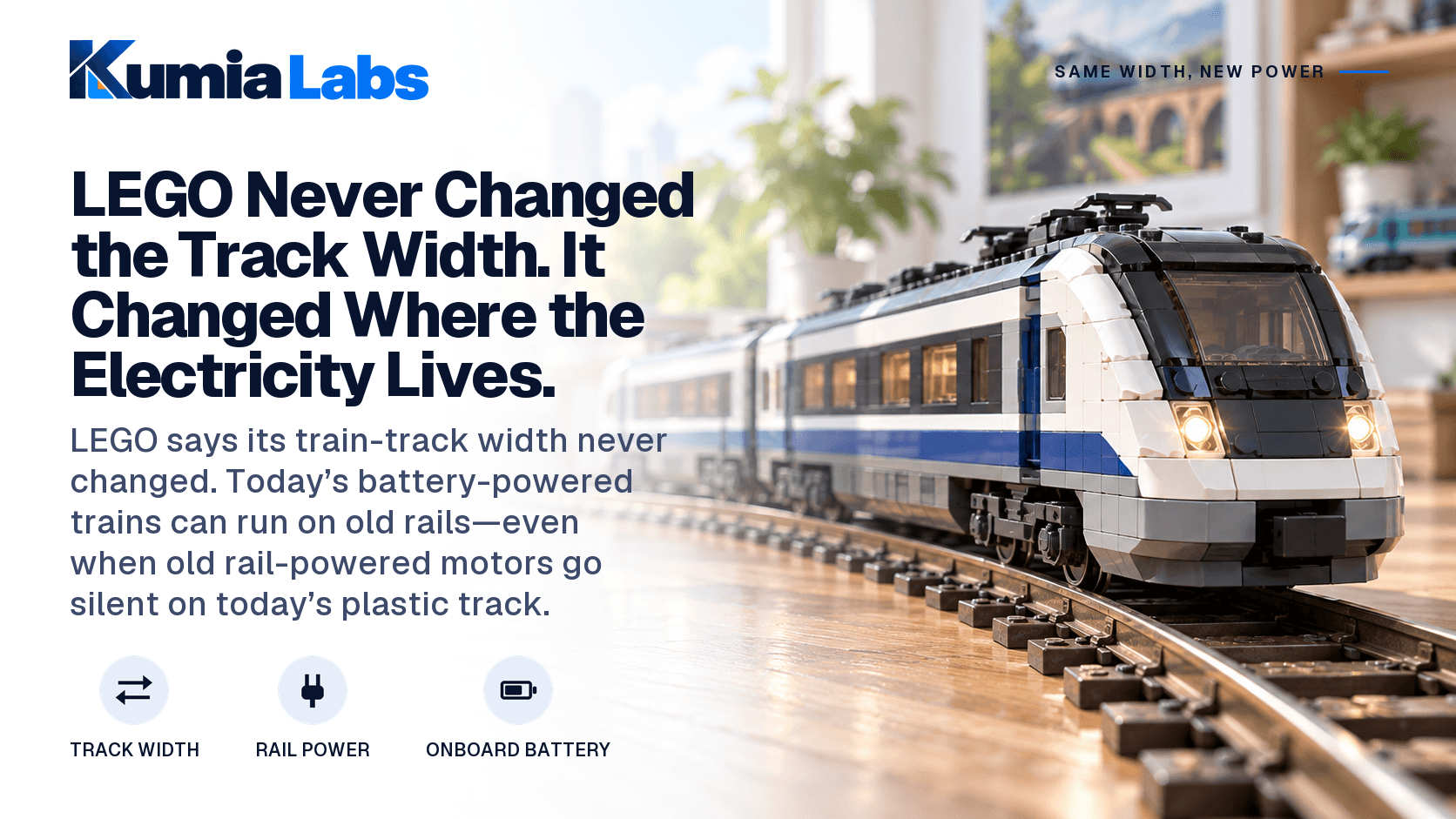

One measurement stayed the same. Everything that powers the train moved around it.
Imagine finding a loop of old LEGO train track in a box from childhood. Some rails look metallic. Recent motorized LEGO trains use plastic track and onboard batteries with wireless control. They appear to belong to different worlds—and electrically, they do.
But LEGO says one crucial measurement never moved: the width of the track.LEGO City FAQ ↗
That means a current battery-powered train can run on old rails. Put an old 9V rail-powered locomotive on today’s plastic track, however, and you get a stranger result. The wheels fit. The rails guide them. The motor receives no electricity.LEGO City FAQ ↗LEGO Help ↗
The track remembers the train. The power system does not always return the favor.
The road stayed; the power moved
The easiest way to understand this is to forget the generation names for a moment.
A modern LEGO train carries its energy onboard. Its battery hub sends power to the motor, and Bluetooth sends the driver’s instructions. The track mostly supplies a path.
An older 9V train treats the layout as part of the machine. Electricity runs through metal rails and enters the motor through metal contacts in the wheels. Replace those conductive rails with all-plastic track and the path remains, but the circuit disappears.LEGO Help ↗Set 7499 ↗
That is why compatibility here is lopsided. The self-contained modern train asks very little of old track. The old train asks modern track for electricity it was never designed to provide.
LEGO’s own Help page puts the distinction plainly: newer Power Functions and Powered Up trains can run on both old and current track because they carry an internal battery box. Old 9V and 12V systems need their appropriate older metal-equipped powered track and control equipment to move under their original power arrangements.LEGO Help ↗
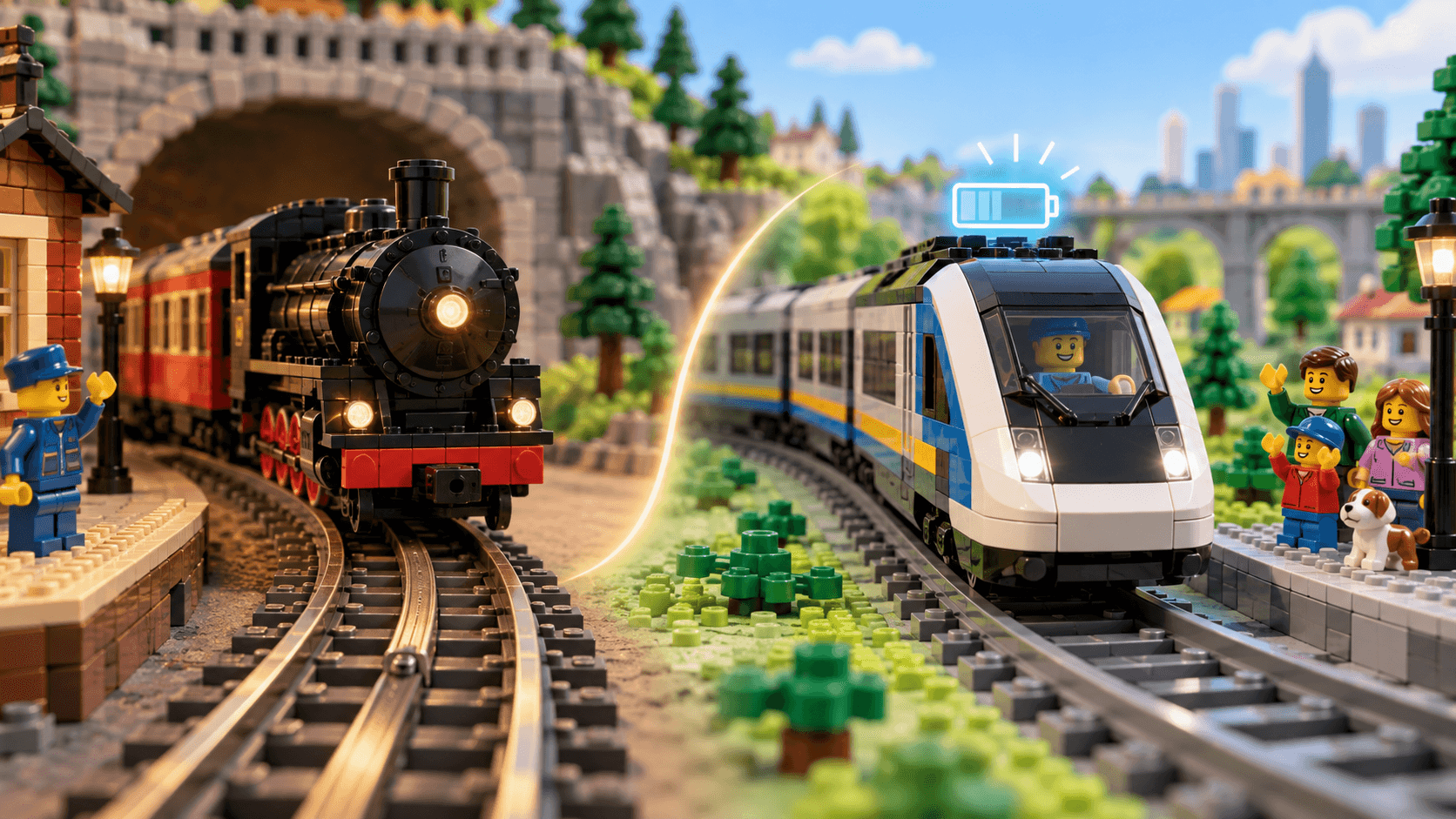
The width stayed useful while power moved from specialized rails back aboard the train.
Conceptual — not to scale
Old 9V: the track is part of the circuit
- Controller / supply
- Metal running rails
- Metal wheel contacts
- Motor
Plastic rail can guide the wheels but cannot complete this original power path.
Powered Up: the circuit rides onboard
- Battery hub
- Cable
- Train motor
Old metal or current plastic track supplies the path, not the electricity.
A separate note on 12V
LEGO’s 1969 12V system used electric rails placed between the running rails and connected to a transformer. Do not read the 9V drawing as a 12V diagram.
LEGO trains have moved the electricity before
The funny part is that power did not travel in one direction through history.
The first fully movable plastic LEGO train appeared in 1964. In 1966, LEGO put a 4.5-volt battery onboard a train running on blue rails.Train history ↗Product development ↗
Two years later came a control system that now sounds like a smart-home experiment from the wrong decade: a special whistle made the train drive, stop, and reverse.Train history ↗
Then electricity moved into the layout. In 1969, a 12-volt system added powered rails between the running rails and connected them to a transformer. In 1991, the 9-volt system sent electricity through the running rails themselves and molded the rail sections in one piece.Train history ↗Product development ↗
Later battery systems moved the source onboard again. A 2010 Power Functions passenger train used a battery box and infrared remote. By 2018, Powered Up trains were using Bluetooth.Set 7938 ↗Set 60197 ↗About Powered Up ↗
So the story is not a clean march from primitive to modern. It is more like a relay race: onboard battery, powered center rails, powered running rails, onboard battery again.
Through those changes, LEGO says the width never changed.
A system designed to keep growing
One account from LEGO’s 1969 train leaflet makes the continuity feel less accidental. It described a child starting with a push-along train, adding a battery motor, and later adding a 12-volt motor and transformer. The same train would grow in function, the leaflet explained, and nothing had to be thrown away.Train history ↗
That promise belonged to its own era; it is not proof that every part made since then plugs into every other part. But it shows the idea LEGO was selling: a system could change without making earlier play meaningless.
The surviving track width is a remarkably visible version of that idea. An old wagon can still roll in a new layout. A newer battery locomotive can travel over an older rail. The electricity may have changed address, but the wheels still know where home is.
LEGO preserved another surprising bridge between generations of play in a completely different size: DUPLO looks separate, yet was designed to connect back to standard LEGO.
The combinations that feel like time travel
A Powered Up train on old metal track. The train brings its own battery, so the old rail does not have to provide power.LEGO City FAQ ↗LEGO Help ↗
An older unpowered car behind a new train. LEGO says train cars from earlier models run on new tracks and attach to new trains. That makes a mixed-generation train more than a display idea.LEGO City FAQ ↗
An old 9V locomotive on current plastic track. It demonstrates the limit: physical fit survives, original rail power does not. Do not force or energize unfamiliar equipment.LEGO Help ↗Set 7499 ↗
A running train, lifted off the rails. A Powered Up train can even keep running when lifted off the track, according to LEGO’s City FAQ—a neat clue that the power is onboard.LEGO City FAQ ↗
A 12V and a 9V layout side by side. Both are “old electric LEGO trains,” but 12V used separate electric rails between the running rails; 9V powered the running rails themselves. One label should never erase that difference.Train history ↗
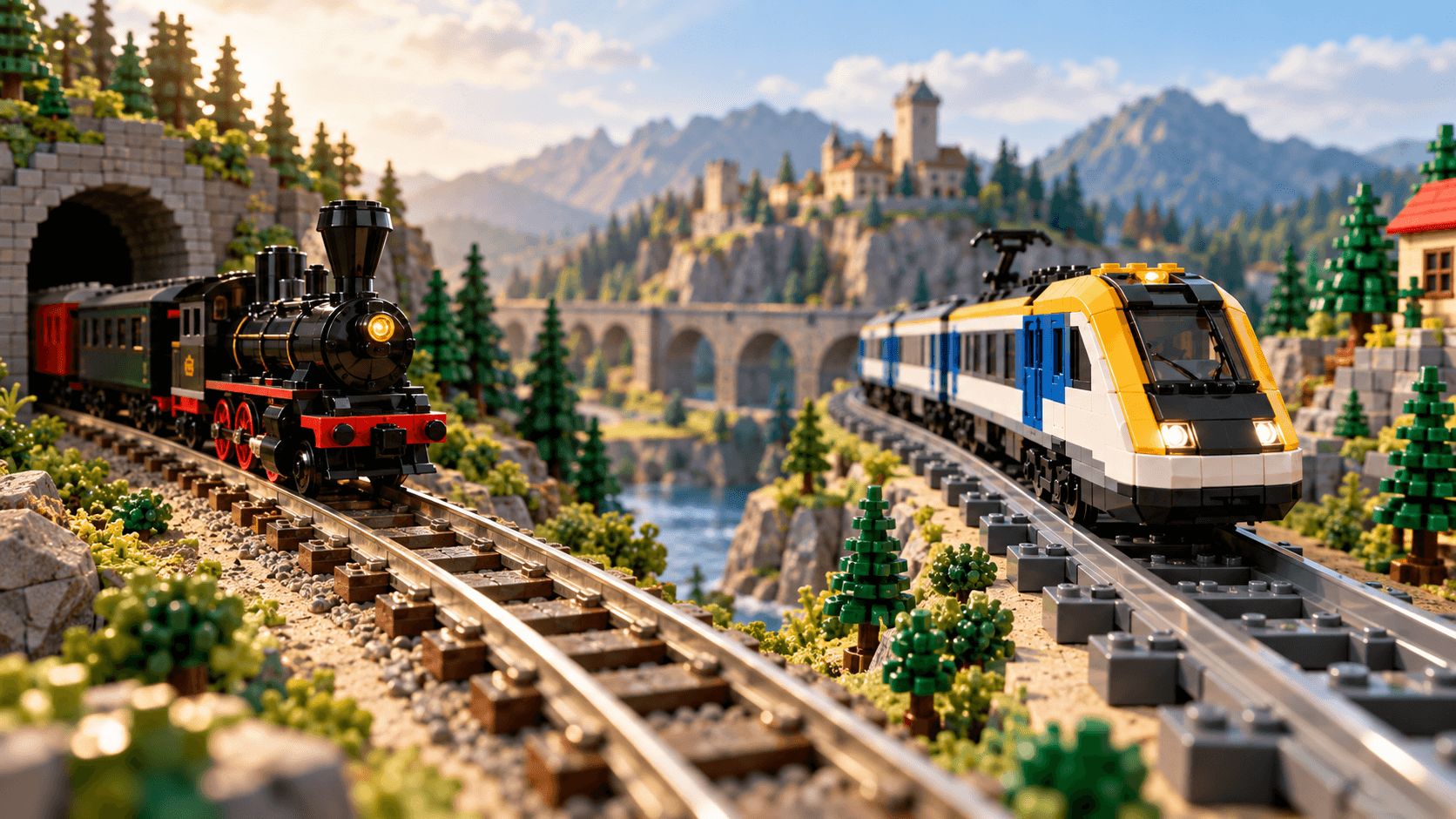
LEGO says newer onboard-battery trains can run on older track because the train carries its own power.
Where the neat story stops
“LEGO never changed the width” is not the same as “nothing changed.”
It does not prove that every old track piece directly clips to every new one. Track connectors and construction changed. It does not guarantee that a long custom locomotive clears every curve or switch. It does not make brittle wiring, corroded contacts, or incomplete transformers safe.
It also does not make Power Functions and Powered Up electronics interchangeable. One used infrared and older connectors; the other uses Bluetooth and new plugs. They share the ability to bring batteries onboard, not the same electronic language.About Powered Up ↗Set 60197 ↗
And 9V is not shorthand for every old electric train. A 12V train needs its appropriate center power rails and transformer/control system. A 9V train needs the correct conductive running rails and control equipment. Today’s plastic track powers neither through the rails.LEGO Help ↗Train history ↗
The useful sentence is narrower and better: the same width preserves a path, while the power source decides whether a motor can use it.
A SMALL EXPLORER · OPTIONAL
Will it run here?
Use the small explorer here to choose a train type and a track type. It returns one of four results: FITS & RUNS, FITS — NEEDS THE RIGHT POWER, ROLLS — NO MOTOR NEEDED, or CHECK FIRST.
It deliberately does not answer whether two generations of track pieces clip directly together. LEGO’s official sources establish train-on-track behavior much more broadly than they establish every track-to-track joint.
Official broad cases, not a complete train-part database.
FITS & RUNS
The train carries its battery onboard, so the old rail only has to guide the wheels.
Where power comes from: Onboard battery.
Sources (checked 2026-09-20): LEGO City FAQ ↗LEGO Help ↗Set 60197 ↗
This does not tell you whether two generations of track pieces clip directly together. LEGO’s sources cover trains on track much more broadly than every track-to-track joint.
What you can try today
Start with the least expensive experiment: use what is already in the box.
If the train has a battery box or hub onboard, place it on clean, intact old LEGO train track of the same family width and follow its normal operating instructions. If it runs, the old track is acting as a road, not a wire.
If the locomotive is an old 9V or 12V model and you have only current plastic track, expect it to fit but not receive rail power. Roll an unpowered wagon by hand instead, or let a supported newer locomotive pull an older car.
For a visual demonstration, place one section of old metal-looking rail beside one current plastic section without claiming they connect. The difference tells the story before the motor even starts.
Old electrical equipment deserves restraint. If the correct controller, transformer, cable, or instructions are missing—or any wiring looks damaged—stop at the unpowered rolling experiment.
If the story makes you want a train again
Already have a newer battery-powered train and old LEGO track? Buy nothing first. LEGO says the new train can use old track; inspect the pieces and follow the train’s normal instructions.
LEGO currently sells plastic track packs, including straight, curved, flexible, and switch sections. Those are useful for a current battery-powered layout, but they do not restore rail power to an old 9V or 12V motor.
More track for a battery-powered layout
LEGO Tracks 60205
Current plastic track: 8 straight, 4 curved, and 8 flexible sections.
Watch for: it guides trains but supplies no rail power. Check the current price and availability at LEGO.
Optional: a bigger layout
LEGO Switch Tracks 60238
Current plastic track with 4 curves and left and right switches.
Watch for: it is current plastic track, not a solution for old 9V or 12V power. Check the current price and availability at LEGO.
The current Vintage Steam Train and Harbor Freight Train are appealing story-led starting points, but neither is motorized in the box.
A story-led train to build
Vintage Steam Train 60511
575 pieces, marked for ages 7+, with a track section and station.
Watch for: it is not motorized in the box. Motorization needs separate Powered Up parts, listed below. Check the current price and availability at LEGO.
A larger train to build
Harbor Freight Train with Crane & Truck 60509
803 pieces, marked for ages 7+.
Watch for: it is not motorized in the box either. Motorization needs the same separate Powered Up parts. Check the current price and availability at LEGO.
To motorize one of these, LEGO lists separate Powered Up parts
- Hub 88009, which needs batteries
- Train Motor 88011, which requires that hub
- Remote Control 88010 or an app, for control
Availability of individual parts changes, so confirm that each one is in stock before planning a build. Kumia does not treat this as one ready-to-order bundle.
If you already own old track and a modern battery train, buy nothing first. The most interesting product in this story may be the rail you forgot you had.
The rails kept one promise
LEGO trains changed color, voltage, controls, rail construction, and the place where electricity enters the system. A whistle once drove a train. Metal rails once completed the circuit. Bluetooth now carries the command.
Yet the wheels still find the same-width path.
That is the clever part hiding in an ordinary toy railway: compatibility did not require every generation to stay the same. It required one useful relationship to survive while almost everything around it changed.
Sources and methodology
Sources are LEGO’s own Help, FAQ, history, and product pages, reviewed for the Kumia research package and last checked September 20, 2026. LEGO’s 1969 leaflet account is paraphrased and is not proof of universal compatibility. Kumia Labs did not test these trains or tracks. Third-party rail, conductive tape, altered wiring, custom motors, DUPLO train track, and the direct joining of old and new track sections are outside this article, and the explorer covers only broad official cases. Prices and availability are not shown; confirm them on each LEGO page.
- LEGO City FAQTrack width never changed, earlier cars run on new track, Powered Up runs on old track, 9V and 12V motors need metal rails, and a Powered Up train keeps running when lifted.
- LEGO Help: LEGO TrainsOld metal track powered old motors through metal wheels, newer track lacks metal, all cars sit and connect on both, 9V and 12V need powered old track and a control panel, and Power Functions and Powered Up use an internal battery on both.
- LEGO History: LEGO trainsThe 1964 movable train, the 1966 battery train, the 1968 whistle control, the 1969 12V center rails and growth account, the 1980 color change, and the 1991 9V running-rail power.
- LEGO History: Focus on product developmentThe 1966 4.5V train, the 1969 12V power skid, powered rails and transformer, and the element committee protecting the System in Play idea.
- LEGO: About Powered UpBluetooth and new plugs, replacing infrared Power Functions.
- LEGO: Passenger Train 7938 (retired)A 2010 Power Functions battery and infrared train described as compatible with 9V track, on plastic track that cannot power a 9V train.
- LEGO: Flexible and Straight Tracks 7499 (retired)Plastic track does not conduct electricity and does not power 9V trains.
- LEGO: Passenger Train 60197 (retired)A 2018 Powered Up train with a Bluetooth remote; the older infrared remote is not compatible.
- LEGO US: Vintage Steam Train 60511575 pieces, ages 7+. Not motorized in the box; Hub 88009, Train Motor 88011, and Remote 88010 or an app are separate.
- LEGO US: Harbor Freight Train with Crane & Truck 60509803 pieces, ages 7+. Not motorized in the box; separate Powered Up components are needed.
- LEGO US: Tracks 60205Current plastic track: 8 straight, 4 curved, and 8 flexible sections.
- LEGO US: Switch Tracks 60238Current plastic track with 4 curves and left and right switches.
- LEGO US: Train Motor 88011A Powered Up train motor that requires Hub 88009.
- LEGO US: Hub 88009The Bluetooth Powered Up hub; batteries required.
- LEGO US: Remote Control 88010Bluetooth control for Hub 88009; batteries required.