V2 FIND 001 · TOOLS
8 Cordless Tool Combinations to Start—and Grow—Your DIY Setup
Find the right mix for your projects, budget, and future plans.
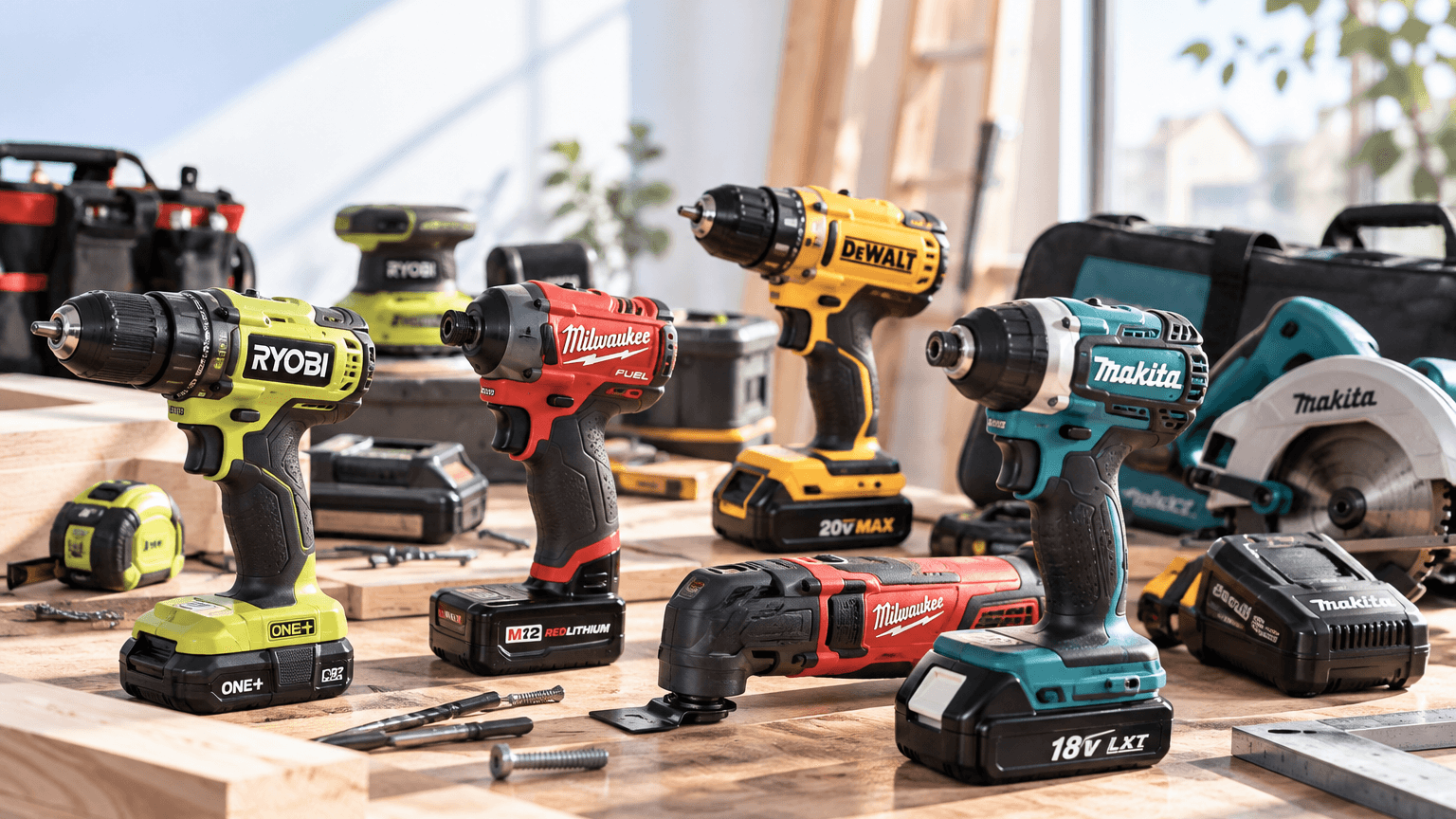
The drill and impact in the box are only half the decision. Their batteries determine which bare tools you can add next, while tool size and kit breadth decide whether the setup feels useful on day one. The best combination changes with the work.
QUICK VERDICT
Four useful starting directions

FIND YOUR COMBINATION
Build around the work, not the badge
Choose four priorities. The Finder weighs project fit, handling, how much you want on day one, and frequency. When scores tie, a documented value-oriented order breaks the tie rather than silently favoring the editorial rank.
Answer all four questions to see your recommended combination.
KUMIA’S TOP COMBINATIONS
Eight different ways to begin
These are not eight versions of the same recommendation. Some buy compactness, others buy renovation capacity, and the six-tool setup buys time by putting more tools in the workshop immediately.
BEST FORThe lowest-commitment first setup
RYOBI ONE+ × Drill/Impact Starter
18V ONE+ · PCL1200K2
PCL206 drill/driver, PCL235 impact driver, two 1.5Ah batteries, charger, and bag.
The pair covers shelf mounting, flat-pack furniture, pilot holes, and ordinary fasteners while leaving a useful path to saws, sanders, and outdoor tools.
Both tools share RYOBI’s 18V ONE+ packs. This base kit uses small 1.5Ah batteries that keep weight down but limit runtime.
Weekend repairs and occasional DIY when the next tool is not yet clear.
Brushed, entry-tier tools and small batteries are less comfortable for repeated heavy work.
You already know masonry drilling or renovation-scale work is coming.
BEST FORTight spaces and overhead work
Milwaukee M12 FUEL × Hammer Drill/Impact
M12 · 12V nominal · 3497-22
3404-20 hammer drill, 3453-20 impact, one 2.0Ah and one 4.0Ah battery, charger, and bag.
A genuinely smaller 12V platform makes cabinet work, electrical boxes, and engine bays easier without reducing the tools to light-duty toys.
M12 batteries work across M12 tools, but they do not fit Milwaukee M18 tools. The included compact and extended packs serve different handling needs.
Frequent work where reach, control, and carrying weight matter more than maximum output.
Choosing M12 does not start an M18 battery collection, and the ecosystem is smaller than the large 18V-class platforms.
Your near-term plan centers on sustained heavy drilling, large fasteners, or full renovations.
BEST FORCompact tools in a broad 18V-class platform
DEWALT ATOMIC × Compact Drill/Impact
20V MAX · 18V nominal · DCK225D2
DCD794 drill, DCF809 impact, two 2.0Ah batteries, charger, bag, and belt hooks.
The short brushless tools handle confined spaces while staying inside DEWALT’s mainstream 20V MAX battery family.
20V MAX describes peak no-load voltage; the platform is 18V nominal. The 2.0Ah packs prioritize size rather than long runtime.
Regular DIY and woodworking when compact size and future platform breadth both matter.
The compact kit is not a substitute for a hammer-drill setup when concrete or sustained high-load work is routine.
You want the smallest dedicated system or need renovation-class hammer drilling now.
BEST FORRegular shop work with masonry capability
Makita 18V LXT × Brushless Hammer Drill/Impact
18V LXT · XT296SMR
XPH16Z hammer drill, XDT14Z four-speed impact, 2.0Ah and 4.0Ah batteries, charger, and bag.
Hammer drilling, Quick-Shift impact control, and Star Protection make this a more deliberate long-term workshop choice than a basic starter pair.
The two capacities balance light handling and longer work. Ah mainly describes stored energy and runtime, not torque by itself.
Woodworking, installation, and renovation where tool control and protection features justify the larger first purchase.
It costs and weighs more than the compact starters, and the included batteries are not a matched pair.
Most tasks are occasional screwdriving and holes in wood or drywall.
BEST FORCompact 18V tools with service coverage
RIDGID NUKE × SubCompact Drill/Impact
RIDGID 18V · RNKSCK201
Brushless drill and impact, two 2.0Ah MAX Output batteries, charger, belt hooks, and bag.
NUKE brings compact bodies without creating a separate battery island: the tools use ordinary RIDGID 18V batteries.
The packs, charger, and tools are cross-compatible with RIDGID’s standard 18V lineup.
Regular compact DIY for buyers willing to complete the warranty paperwork promptly.
Lifetime Service Agreement eligibility is not automatic; registration is required within 90 days of purchase.
You will forget registration or want a much larger add-on-tool catalog.
BEST FORA verified value-oriented brushless pair
CRAFTSMAN V20 RP × Brushless Drill/Impact
V20 · 18V nominal · CMCK211C2
CMCD713 drill, CMCF813 impact, two 1.5Ah batteries, charger, accessories, and bag.
This confirmed current model keeps a brushless two-tool option in the comparison without relying on the unverified CMCK1411D2 listing.
V20 uses 20V maximum initial-voltage branding and operates as an 18V-nominal platform.
Light-to-regular repair work when this exact kit is locally available and priced well.
The small batteries favor handling over runtime, and platform breadth is less clearly documented than the larger ecosystems here.
Expansion range is more important than the initial deal.
BEST FORDemanding renovation
Milwaukee M18 FUEL × Hammer Drill/Impact
M18 · 18V nominal · 3697-22
M18 FUEL hammer drill and impact, two 5.0Ah batteries, M18/M12 charger, and case.
High-output tools, large matched batteries, and AutoStop bind-up control suit repeated large fasteners and masonry drilling.
M18 batteries do not fit M12 tools. The charger accepts both systems, but that does not make their batteries interchangeable.
Frequent renovation and demanding work where runtime and hammer-drill capability earn their weight.
The most substantial and expensive starting commitment in this comparison.
You mostly assemble furniture or work overhead in tight spaces.
BEST FORBuying the basic workshop at once
RYOBI ONE+ × Six-Tool Day-One Setup
18V ONE+ · PCL1600K2
Drill, impact, reciprocating saw, circular saw, multi-tool, LED work light, 1.5Ah and 4.0Ah batteries, charger, and bag.
It solves a timing problem rather than a performance problem: cutting, sanding, fastening, and lighting tools arrive on day one.
It uses the same ONE+ battery platform as combination 01. The six-tool count includes the LED work light.
A new home or planned project list that already includes cutting and sanding in the next few months.
The tools are standard entry-tier ONE+, and buying breadth is wasted if half the kit remains unused.
You only need holes and fasteners now, or would rather buy higher-tier tools individually.
HOW TO CHOOSE A BATTERY SYSTEM
The battery is the part you keep buying into
A bare tool usually costs less than another complete kit because it omits the battery and charger. That advantage only exists inside the same platform. Milwaukee M12 and M18 are separate systems even though one charger can accept both; their batteries do not interchange. RIDGID NUKE works the other way: the compact tools still accept standard RIDGID 18V packs.
Battery capacity in amp-hours mainly affects stored energy and runtime. A larger pack may support demanding use better, but its Ah number is not a torque rating. It also adds weight, which matters overhead or inside a cabinet. DEWALT 20V MAX and CRAFTSMAN V20 are 18V nominal systems—the larger label is maximum initial voltage, not proof that they outrank tools labeled 18V.
Ecosystem size is useful only when it contains the tools you expect to buy. List the next two purchases first: perhaps a circular saw and sander, or an inflator and ratchet. Then check those exact bare tools instead of choosing from an approximate platform-wide product count.
WHAT TO BUY FIRST
Match the first box to the next six months
Drill only
Shelves, pilot holes, anchors, and light assembly are enough reason to begin with one drill. If longer wood screws or repeated furniture builds appear on the list, the impact driver soon earns its place.
Compare the value starter →Drill + impact
This is the balanced choice for furniture, deck repair, and general fixing. Compact work points toward M12, ATOMIC, or NUKE; masonry and heavier renovation point toward Makita or M18.
Compare compact pairs →Multi-tool kit
Buy breadth only when cutting and sanding jobs are already scheduled. RYOBI’s six-tool box includes five conventional power tools plus an LED work light, so judge it by the work you will actually use.
See the day-one setup →KUMIA’S CONCLUSION
I would buy for the second project, not the tenth.
If I owned no cordless tools and spent weekends on home repairs and furniture, I would start with the RYOBI two-tool kit. When a circular saw becomes necessary a few months later, adding one on the same battery matters more to me than buying the highest-torque drill on day one.
I would change that answer for a real constraint. Cabinets, electrical work, or engine bays would move me to M12 because smaller tools affect every minute of the job. A renovation with masonry and repeated heavy fastening would justify starting with M18 FUEL or Makita LXT rather than replacing an entry kit later.