
Three Companies Built Wooden Trains That Somehow Speak the Same Language

The most durable standard in the playroom may be the one nobody formally published.
Put three pieces of wooden railway track on the floor: one from BRIO, one from a classic Thomas Wooden Railway set, and one from IKEA’s LILLABO line.
In many cases, the round peg on one piece will slide into the socket on another. The two grooves will meet closely enough for a little wooden engine to roll across the seam.
There is no pairing button. No branded hub. No license check. Three companies have simply agreed in wood.
Except they do not appear to have sat down and agreed on it at all.
No public cross-company specification emerged in this research. Instead, these toys share a physical language: two running grooves, a familiar track width, a rounded male connector, a matching female recess, and curve conventions that are often close enough to combine.
Compatibility is the visible trick. The more interesting story is how one company’s design became useful enough that rivals, licensors, and a furniture retailer kept speaking it for decades.
BRIO writes the first grammar
BRIO dates its first miniature railway set to 1958. The company says the standardized gauge and connectors it pioneered then are the reason BRIO products remain compatible with many other wooden railway brands today. It also says BRIO World is fully compatible with BRIO Classic and My First Railway. BRIO ↗
That continuity was not passive. In a 2014 anniversary release, BRIO described old-to-new fit as a product-development principle: new toys were meant to connect not just emotionally but literally with older ones. BRIO 2014 ↗
Every BRIO set that stayed in a toy box, classroom, attic, or secondhand shop increased the value of making the next track compatible with it. BRIO was not merely selling pieces. It was accumulating an installed base.
What the wooden-railway language contains
A joint can connect while a loop or accessory still fails.
- 01End connectionConnector fit
- 02Running pathGroove alignment
- 03Layout geometryLoop closure
- 04Vehicle envelopeClearance
Thomas keeps the grammar and changes the sound
A federal appellate opinion about Learning Curve’s Clickety-Clack track describes a meeting at the February 1993 American International Toy Fair. Roy Wilson said the company held the Britt Allcroft license to develop Thomas trains and accessories. More revealingly, the opinion says Learning Curve’s existing wooden track was virtually identical to BRIO track—and that BRIO held the lion’s share of the market. Court record ↗
Learning Curve found its distinction on top of the rail rather than at the ends. Grooves cut across the running channels made the wheels click as they passed, suggesting real rails and ties.
The company was selling Clickety-Clack track by December 1994. Its patent application had been filed that March, and US 5,454,513 was granted in October 1995. The patent’s novelty lies in the sound-producing surface, simulated ties, and reversible faces—not a new incompatible connector. Court record ↗ Patent ↗
Whatever the intent, it worked like good platform strategy. Compatibility enlarged the world available to both products, even while their companies competed for the sale.
IKEA treats the language as market infrastructure
IKEA Australia says LILLABO has been in the range since the 1990s, while current product pages say the track combines with most other railway systems on the market. IKEA US ↗ IKEA history ↗
An IKEA Sweden support answer is more explicit. In translation, it says LILLABO is designed with the standard dimensions used by railway systems on the market and is therefore usually compatible with the vast majority of other systems. It immediately adds that IKEA cannot guarantee compatibility with new railway tracks produced in the market. IKEA FAQ ↗
That careful wording captures the ecosystem better than a simple yes or no. It describes a market convention stable enough to design around, but variable enough that no manufacturer can promise every future joint.
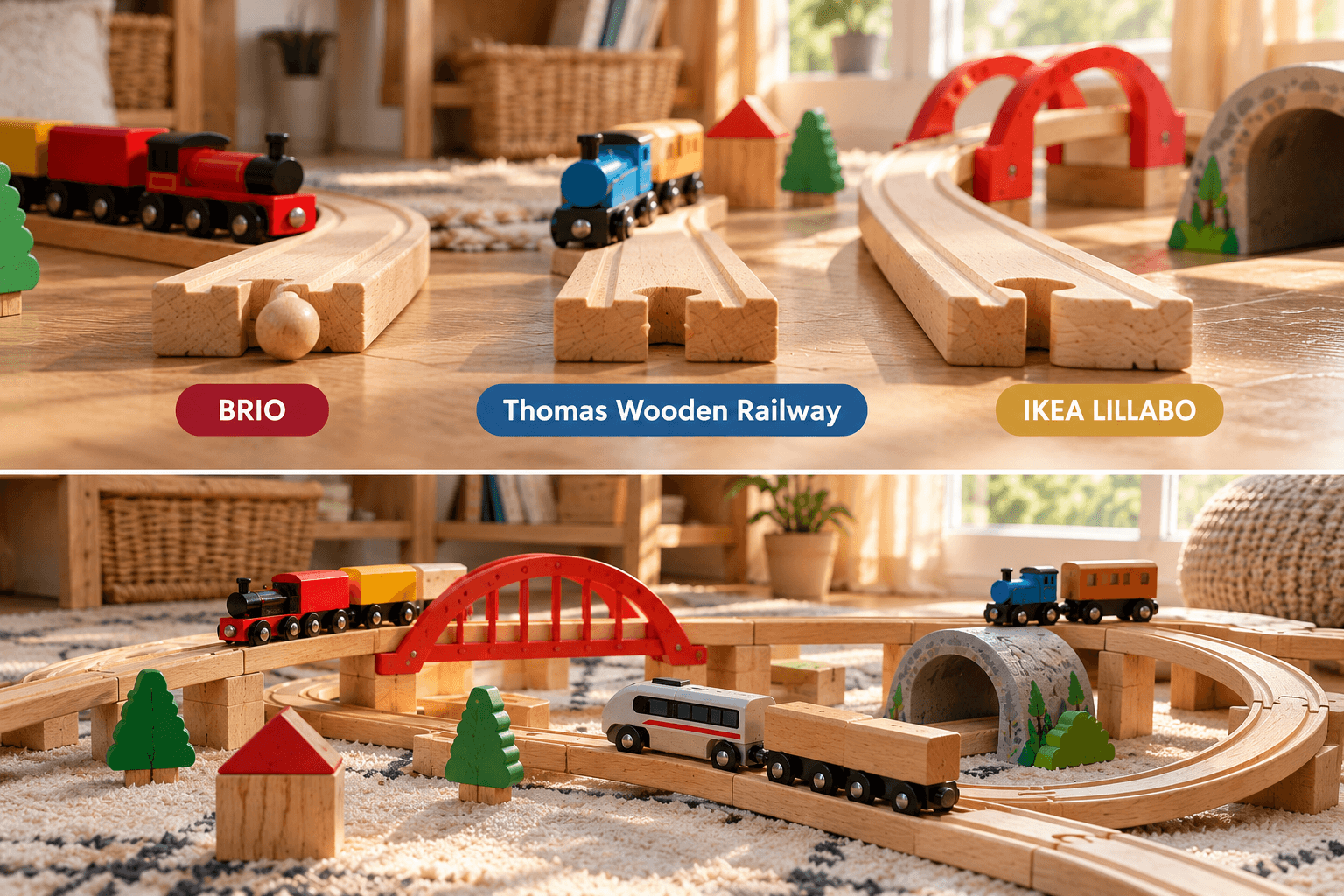
Conceptual editorial illustration, not a product photograph or a dimensional reference. The labels name the three systems in this story; the fit evidence lives in the manufacturer sources and the diagrams below.
The exception that proves the ecosystem
In 2017, Mattel changed the Thomas wooden-track language. Thomas Wood advertised a redesigned track with unique connectors and “no wrong way to build.” Instead of one male and one female end, the new pieces used a symmetric-looking interface intended to make assembly easier for small hands. Mattel 2017 ↗
The official instruction sheet shows the cost of that decision: Mattel included two adapters for other wood track, including classic Thomas Wooden Railway. Related official product pages explicitly name BRIO and other wood systems. 2017 manual ↗ Adapter targets ↗
Together, the pieces formed a bilingual bridge. Thomas Wood could simplify its own tracks only by preserving a path back to the installed ecosystem.
The 2022 adapters mean something else
Mattel lists its Thomas & Friends Wooden Railway Clackety Track Pack as a 2022 release. The product restores the familiar visual language and includes four adapters compatible with Wooden Railway track. Mattel 2022 ↗
The official manual image appears to show two double-male and two double-female pieces. That looks like an orientation correction inside the familiar connector family—not a bridge from Thomas Wood to BRIO. The function remains a visual inference rather than manufacturer-stated geometry. 2022 manual ↗
The names differ too. Learning Curve’s 1990s product was Clickety-Clack track. Mattel’s 2022 pack is Clackety Track. They share the idea of sound, but they are not the same product or patent story.
Two Thomas adapter jobs
Same word, different translation problem.
2017
Thomas Wood bridge adapters
Crosses between connector systems. Mattel’s pair connects the different Thomas Wood interface to classic male and female wooden-track endings.
2022
Clackety Track correction adapters
Appears to correct orientation inside the familiar family. The double-ended function is an inference from Mattel’s official manual image, not a manufacturer-stated geometry.
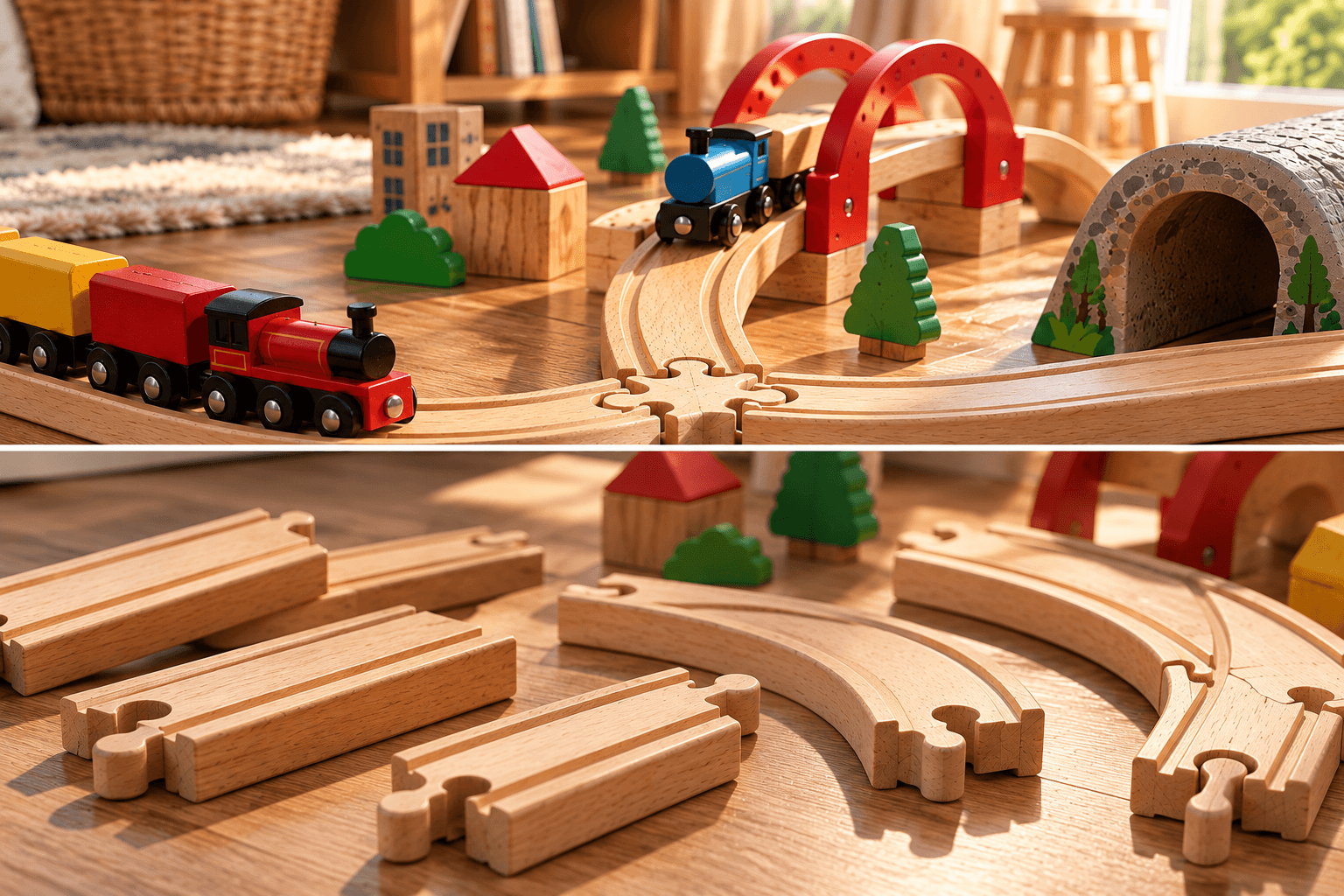
Conceptual editorial illustration. A joint that looks right is only the first of the four checks below.
Compatibility can break in four different places
The shared language is real, but it is not magic. Before combining systems, test four layers.
- End connection / connector fit.Does the peg enter the socket gently and stay joined without lifting the track?
- Running path / groove alignment.Can wheels cross the joint without climbing, catching, or dropping?
- Layout geometry / loop closure.Do mixed curves and switches return to the final joint without accumulating a gap?
- Vehicle envelope / clearance.Does the widest and tallest vehicle clear every bridge, tunnel, platform, and accessory?
IKEA’s own wording supports this caution. It says most systems, not all. Current customer reviews include both successful combinations and reports of joints that are too tight or do not fit. Reviews are anecdotal, but the disagreement is exactly what a tolerance-based ecosystem should produce. IKEA US ↗
FAMILY-LEVEL GUIDANCE · TEST THE PIECES IN FRONT OF YOU
What can you actually combine?
These verdicts describe connector families. They do not promise that every mixed loop closes or every vehicle clears every accessory.
| System A | System B | Verdict | Confidence | Required caveat |
|---|---|---|---|---|
| BRIO World | BRIO Classic / My First | DIRECT | High | Official BRIO family claim. |
| Classic Thomas Wooden Railway | BRIO-language track | DIRECT | High at family-history level | Test exact generations, bridges, curves, and accessories. |
| Thomas Wood 2017–2021 | Classic Thomas Wooden Railway | ADAPTER BRIDGE | High | Use the 2017 Thomas Wood bridge pair. |
| Thomas Wood 2017–2021 | BRIO | ADAPTER BRIDGE | High | Mattel names BRIO; the adapter does not certify every layout. |
| Thomas Wooden Railway 2022 | Classic Thomas Wooden Railway | DIRECT | Medium-high | Exact legacy pieces and accessories still deserve a fit test. |
| Thomas Wooden Railway 2022 | BRIO / other wooden brands | CHECK FIRST | Medium | Mattel claims broad compatibility but does not certify every brand and generation. |
| IKEA LILLABO | BRIO / classic Thomas | CHECK FIRST | Medium-high | IKEA says most systems, not all systems. |
| Wooden Railway | TrackMaster / Take-n-Play | DIFFERENT SYSTEM | High | Different material and connector families. |
BRIO World
with BRIO Classic / My First
- Confidence
- High
- Check
- Official BRIO family claim.
Classic Thomas Wooden Railway
with BRIO-language track
- Confidence
- High at family-history level
- Check
- Test exact generations, bridges, curves, and accessories.
Thomas Wood 2017–2021
with Classic Thomas Wooden Railway
- Confidence
- High
- Check
- Use the 2017 Thomas Wood bridge pair.
Thomas Wood 2017–2021
with BRIO
- Confidence
- High
- Check
- Mattel names BRIO; the adapter does not certify every layout.
Thomas Wooden Railway 2022
with Classic Thomas Wooden Railway
- Confidence
- Medium-high
- Check
- Exact legacy pieces and accessories still deserve a fit test.
Thomas Wooden Railway 2022
with BRIO / other wooden brands
- Confidence
- Medium
- Check
- Mattel claims broad compatibility but does not certify every brand and generation.
IKEA LILLABO
with BRIO / classic Thomas
- Confidence
- Medium-high
- Check
- IKEA says most systems, not all systems.
Wooden Railway
with TrackMaster / Take-n-Play
- Confidence
- High
- Check
- Different material and connector families.
Evidence: BRIO ↗ Court record ↗ Mattel 2017 ↗ 2017 manual ↗ Adapter targets ↗ Mattel 2022 ↗ IKEA FAQ ↗
A FOUR-STEP FIELD GUIDE · NO DATABASE REQUIRED
Test the language on your floor
- 01Test the end connection
Join one known straight piece gently. Never force swollen, painted, or tight wood.
- 02Test the running path
Roll a vehicle across the grooves at the joint and watch the wheels.
- 03Close a small mixed-brand loop
Repeated angle differences become obvious at the final joint.
- 04Test the vehicle envelope
Run the widest and tallest vehicle through every accessory.
Before you buy more track
Use what is already in the box. One known straight, one small loop, and your widest vehicle tell you more than a blanket compatibility badge.
If you are shopping secondhand, take a known track piece with you when practical. Do not buy a legacy Thomas Wood adapter as if it were a current universal solution, and do not assume a connector match guarantees every bridge or curve.
No product card is included here. The evidence supports reuse-first testing better than a universal buying recommendation.
The standard nobody had to publish
BRIO created a useful grammar in 1958 and kept teaching it through backward-compatible products. Learning Curve preserved a BRIO-like grammar while differentiating Thomas with characters and sound; the installed-base effect is an editorial explanation of why that compatibility mattered, not a stated company motive.
BRIO later put Thomas directly inside its own catalog. IKEA treated the dimensions as a market convention worth designing around. Mattel’s Thomas Wood experiment showed that even a child-friendly alternative needed adapters back to history.
So yes: BRIO, classic Thomas Wooden Railway, and IKEA LILLABO can often share a floor. But the satisfying part is not that a peg fits a hole. It is that every old box of track became a tiny vote for the interface.
Three companies did not need to sign the same rulebook. They inherited the same language—and discovered that it was more valuable to keep speaking it.
Sources and methodology
Kumia Labs reviewed manufacturer pages, official manuals, a federal appellate opinion, a granted patent, and archived catalog artifacts on September 23, 2026. The article distinguishes manufacturer statements from visual inference and editorial analysis. It does not claim a public cross-company standard, exact connector dimensions, or universal fit. Catalog scans are linked as evidence and not reproduced.
- BRIO Railway Toys1958 origin, standardized gauge and connectors, and current BRIO family compatibility.
- BRIO celebrates 130 years of playOld-to-new fit as an intentional product-development principle.
- Learning Curve Toys v. PlayWood Toys, Seventh Circuit1993 license record, BRIO comparison, and Clickety-Clack development chronology.
- US5454513A — Toy track sectionSound-producing grooves, simulated ties, reversible track, and patent dates.
- BRIO Thomas & Friends 1998 catalog sheetArchived primary artifact showing BRIO’s licensed Thomas range in 1998.
- BRIO Thomas & Friends 1999 catalog sheetArchived primary artifact showing the same relationship in 1999.
- Thomas Wood Starter Set FHM642017 release, unique connectors, no-wrong-way goal, and included adapters.
- Thomas Wood FHM66 instruction sheetTwo adapters for other wood track, including classic Thomas Wooden Railway.
- Thomas Wood FKF55 official product pageNames classic Thomas, BRIO, Melissa & Doug, Imaginarium, and other wood track.
- Thomas & Friends Wooden Railway Clackety Track Pack HDX062022 release, Wooden Railway compatibility, and four adapters.
- HDX06 instruction sheetOfficial imagery for the familiar track ends and four adapter shapes.
- IKEA US LILLABO 50-piece track setUse with most other railway systems; customer reports vary.
- IKEA Sweden LILLABO compatibility FAQStandard market dimensions, broad compatibility, and no universal guarantee.
- IKEA Australia LILLABO pageLILLABO has been in the range since the 1990s.